
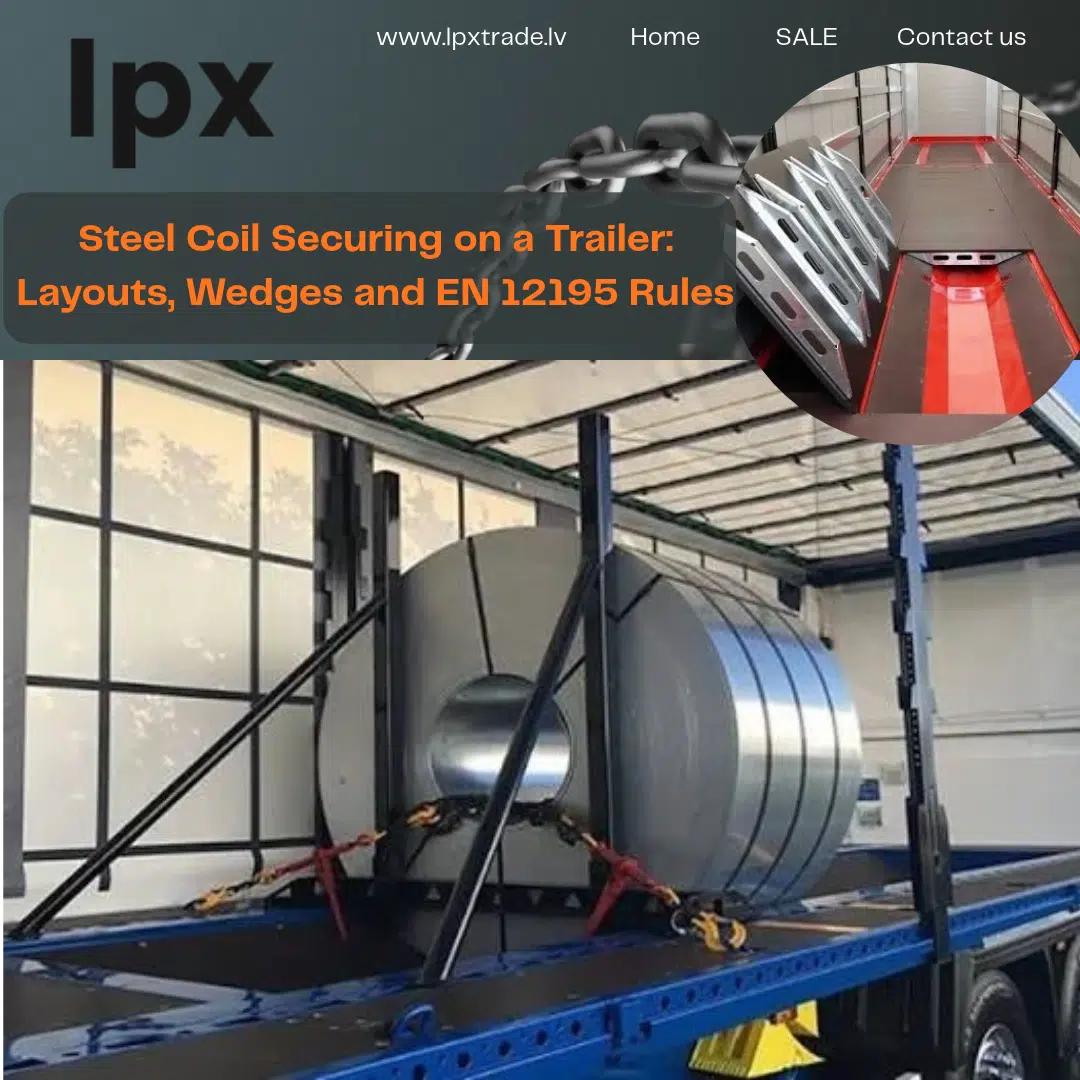
How do you secure a steel coil on a trailer?
Steel coil securing rests on three elements: wedges or a coil well stop the coil rolling, loop lashings at 30–60° stop it shifting, and you size the whole system to EN 12195-1 — 0.8 g forwards and 0.5 g backwards and sideways. Carry a horizontal-axis coil in a coil well or on a cradle. Treat a vertical-axis coil (“eye to sky”) as one of the hardest loads on the road. Above all, never treat the mill’s steel banding as a restraint to the trailer.
A coil is dense cargo, so mistakes cost dearly. In heavy braking, 1 t of cargo pushes forwards with almost 1,000 daN, and a crash produces even more. On top of that, weak securing risks fines of up to €5,000, and your insurer may refuse to pay a claim. Below, we cover the forces, the layout for each coil orientation, wedge sizes and the right lashing gear. For steel with sharp edges you will usually pick chains, and our comparison of lashing chains vs straps explains why.
What forces act on a coil when you brake or swerve?
EN 12195-1 sizes the securing for 0.8 g forwards and 0.5 g backwards and sideways. For a 10-t coil, that means ≈ 8,000 daN forwards and ≈ 5,000 daN backwards and sideways.
Table 1. Forces on a 10-t coil (EN 12195-1) and what a Code L body can take (EN 12642)
| Direction | Coefficient | Force, daN (≈) | What a Code L body takes |
|---|---|---|---|
| Forwards | 0.8 | 8,000 | Headboard: 40% of payload, but no more than 5,000 daN |
| Backwards | 0.5 | 5,000 | Endboard: 25%, but no more than 3,100 daN |
| Sideways | 0.5 | 5,000 | Rigid sideboard: 30%; curtain: 0 |
We simplify: 1 kg ≈ 1 daN, as the European guidelines do. At g = 9.81, the forces come out about 2% lower.
However, the body walls are not your main support. A Code L headboard takes 5,000 daN at most, yet you must hold ≈ 8,000 daN. Friction, stops and lashings cover the difference. Moreover, a coil presses on the wall at a single point, and the European guidelines warn against concentrating load on a small part of the structure. Therefore, the coil well, wedges and lashings do the real work, and the wall acts as a reserve. A curtain does not count at all — see our article on EN 12642 Code XL vs Code L.
Next, calculate the number of lashings twice: once for sliding and once for tipping. Then take the higher figure (European guidelines, section 4). For a horizontal-axis coil, also check rolling, which wedges or a coil well must stop. For formulas and a worked example, read how to calculate LC in 2 minutes.
How do you secure horizontal and vertical coils?
The coil axis decides the whole layout. The European guidelines call the two options “bore horizontal” and “bore vertical”. Ideally, you load horizontal coils with the axis across the vehicle. Then a coil can roll only forwards or backwards, and wedges or a coil well stop that movement. Table 2 compares the layouts.
Table 2. Coil securing layouts by axis position
| Coil position | What stops it rolling | How you lash it | Main risk |
|---|---|---|---|
| Horizontal axis, coil well (wedge bed) | The well | Enough lashings: without them the coil moves in the well | Coil shifts in the well |
| Horizontal axis, cradle on a flat platform | Cradle and soft wedges | Coil to cradle: at least 2 web lashings or approved steel strapping. Cradle to trailer: chains or lashing straps with tensioners. Every transverse row separately | Rolling and tipping |
| Vertical axis (“eye to sky”) | Cruciform with spigots in the coil bore | Chain or strap through the cruciform channel across the vehicle, ends to anchor points | Tipping |
| Coil on a pallet | Pallet and restraint of the whole unit | Banding holds the coil to the pallet during loading only; you lash the whole unit to the trailer | Treating the pallet as secured because it is banded |
Horizontal axis: coil well or cradle
The best option is a trailer with a coil well (wedge bed) built into the platform. Even so, a coil in a well moves unless you add lashings, so you always need them. Without a well, place the coil on a cradle with soft wedges. Then fix the coil to the cradle with at least two web lashings or approved steel strapping. Finally, fix the cradle to the trailer with chains, or with lashing straps and tensioners.
Treat every transverse row of coils separately and lash each one. In addition, protect every coil edge with corner protectors. An anti-slip mat under the cradle also helps, because it lifts friction from ≈ 0.2 to ≈ 0.6.
Vertical axis: why “eye to sky” is harder
The European guidelines rank these coils among the most difficult loads. For large coils, they show a cruciform. Its spigots sit in the coil bore, and a chain or strap runs through its channel across the vehicle to anchor points on the platform. Without a cruciform, you must route straps and chains so that they prevent any movement at all.
In addition, a dense, compact load may need a cluster of heavy-duty anchor points, because standard lashing rings may fall short. For the figures, see our guide to lashing points under EN 12640.
What angle should loop lashings have?
In the coil layouts of the European guidelines, all loop lashing angles fall between 30° and 60°. For direct lashing, the horizontal share of the lashing capacity (LC) equals LC × cos α. As a result, a flatter lashing holds the load better sideways. For more on angles, read LC and lashing angles. For the methods themselves, see our visual guide to the 5 cargo securing methods.
Which wedges, stops and lashing gear do coils need?
Wedges and stops stop rolling, while lashings stop sliding and tipping. Table 3 gives the wedge and stop sizes, and Table 4 helps you choose the gear.
How big must the wedges be?
Table 3. Wedges and stops for coils (European guidelines, sections 2.7 and 3.1.5)
| Element | Parameter | Rule |
|---|---|---|
| Block wedge | Height and angle | At least R/3 without a top-over lashing; no more than 200 mm with one; angle ≈ 45° |
| Pointed wedge | Angle | ≈ 15°; no securing function, only for loading and unloading |
| Wedge bed | Clearance | At least 20 mm between coil and platform; wedge height as for block wedges |
| Stanchions for roll-type cargo | Load | Together they take 0.5 × maximum cargo weight at height H/2 |
R is the coil radius; H is the cargo height above the platform.
Which lashing gear works best?
Table 4. Choosing lashing gear for coils
| Gear | Use | Key points |
|---|---|---|
| Lashing chains (EN 12195-3) | Heavy coils, sharp edges, direct lashing | Never knot them or join them with a bolt; shield them from edges; replace at more than 3% elongation or 10% wear of the nominal diameter |
| Lashing straps, 50 mm (EN 12195-2) | Loop lashings, fixing the coil to the cradle | Typical LC 2,000 daN, up to 7% elongation at LC; use sleeves and corner protectors |
| Steel strapping | Binding coils and pallets together | Not for securing cargo on an open platform |
| Lashing points (EN 12640) | Anchors for chains and straps | At least 2,000 daN on trailers over 12 t; the European guidelines recommend 4,000 daN |
Some producers set stricter rules. For example, the Tata Steel Europe road guideline (revision 4.0, valid until 1 May 2025) calls for lashings of 2,000 daN LC on horizontal coils up to 5 t on stillages. Therefore, always ask the shipper for the current rules.
Pre-departure checklist for coil loads
- The mill banding is intact.
- The coil sits in a well or on a cradle, and the wedges reach at least R/3 (up to 200 mm with a top-over lashing).
- An anti-slip mat lies under the cradle.
- You have lashed every transverse row separately, and at least two lashings fix each coil to its cradle.
- Corner protectors or sleeves shield the coil edges.
- The lashing points take the calculated load (EN 12640).
- You make the first check after a few kilometres at a safe stop, and again after any heavy braking.
Need chains and binders? LPX Trade stocks Grade 80 lashing chains to EN 12195-3 and ratchet load binders, plus lashing straps and shoring bars. A Declaration of Conformity is available on request.
Steel coil securing: frequently asked questions
How do you secure a steel coil on a trailer?
Place the coil in a coil well or on a cradle with timber wedges, then restrain it with chain or strap loop lashings at 30–60°. Fix the coil to the cradle with at least two web lashings or approved steel strapping. Size the securing to EN 12195-1: 0.8 g forwards and 0.5 g backwards and sideways.
Should you use chains or straps for coils?
Both work. For heavy coils in a well, the European guidelines describe loop lashings with straps. For steel and sharp-edged loads, however, they recommend chains to EN 12195-3, which offer high LC and almost no stretch. Straps stretch up to 7% at LC, so they need edge protection.
What is the correct lashing angle for a coil?
For coil loop lashings, the European guidelines show angles between 30° and 60°. In direct lashing, the horizontal share of LC is LC × cos α, so a flatter lashing holds better sideways. A tie-down over the load works the opposite way and needs a steep angle. Calculate the exact number of lashings to EN 12195-1.
How high should wedges be?
Block wedges need a height of at least one third of the coil radius (R/3) when you use no top-over lashing. With a top-over lashing, a wedge of up to 200 mm is enough. The block wedge angle is about 45°. Pointed 15° wedges have no securing function, because they only hold the coil during loading.
How do you transport a coil “eye to sky”?
A vertical-axis coil is among the hardest loads to secure. For large coils, the European guidelines suggest a cruciform whose spigots sit in the bore. A chain or strap passes through its channel across the vehicle to anchor points. Without a cruciform, route straps and chains so that they prevent any movement.
Can you secure a coil with steel strapping?
Not to the trailer. Steel strapping binds a coil to a cradle or pallet, and approved strapping is acceptable for the cradle. However, the European guidelines advise never using it to secure cargo on an open platform. The mill’s banding only holds the coil during loading, so lash the whole unit with chains or straps.
Author: Oļegs Bambuļaks, CEO of LPX Trade SIA, with over 20 years in Baltic logistics and transport management. Last updated: 8 October 2026.
Sources: European Commission, European Best Practice Guidelines on Cargo Securing for Road Transport (sections 2, 3.1.5, 3.2, 4, 6.10); EN 12195-1:2010 (calculation of securing forces); EN 12195-2 (web lashings); EN 12195-3 (lashing chains); EN 12642 (body strength); EN 12640 (lashing points); Tata Steel Europe, Road Standards Restraint Guidelines RSG-RRG-1.0, rev. 4.0.
This article is for guidance. Calculate each journey to EN 12195-1 and follow the trailer and cradle manufacturer’s instructions.