
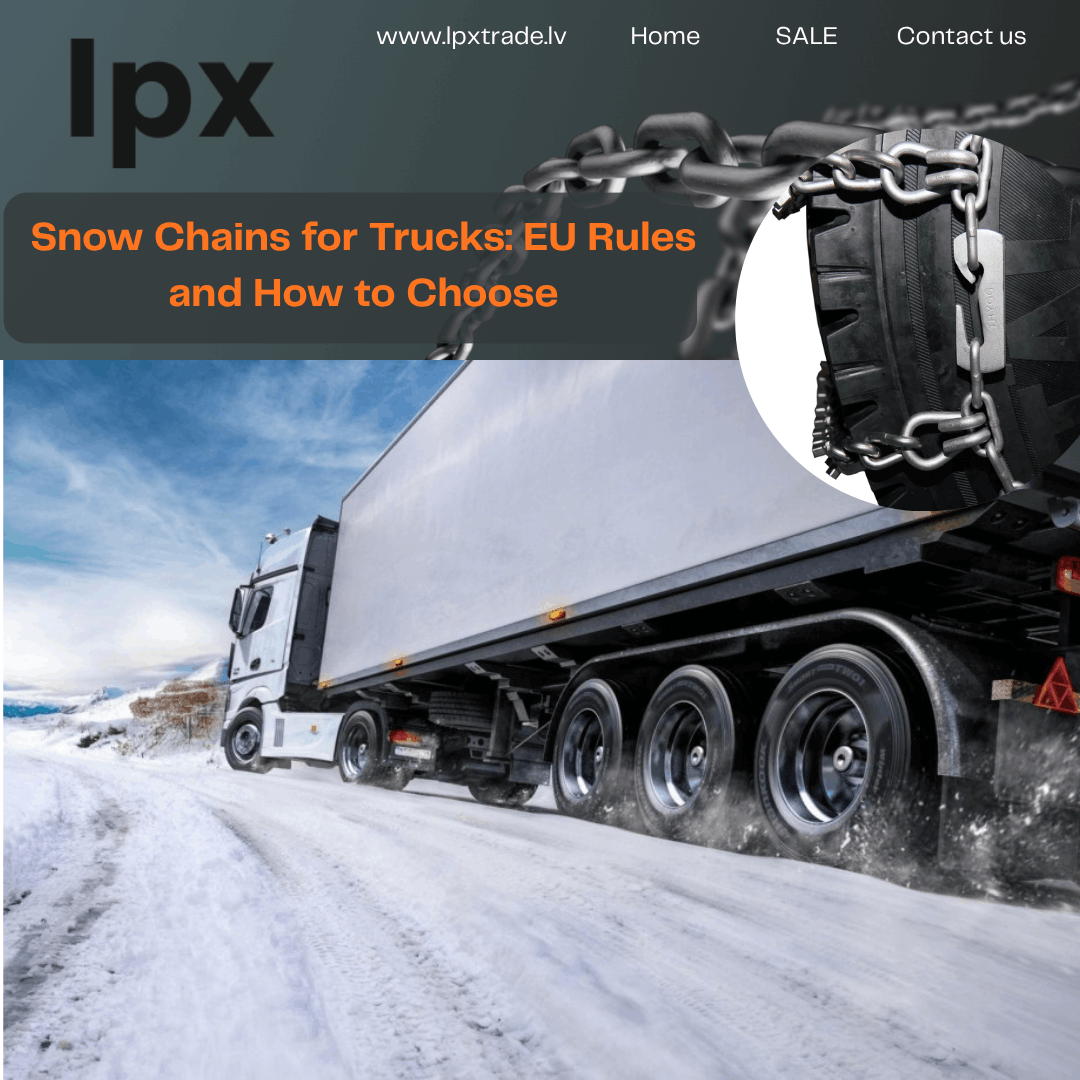
When are snow chains for trucks mandatory, and how do you choose them?
Snow chains for trucks are mandatory wherever the round blue road sign (a wheel-and-chain pictogram) requires them: you may not proceed without them, and the maximum speed with chains fitted is 50 km/h. There is no single EU directive — each country sets its own rules, usually tying the obligation to a road sign or to mountain routes. For certification across the EU, the single harmonised standard EN 16662-1:2020 has applied since 1 January 2023. Moreover, chain choice depends strictly on tyre size and vehicle class.
When are snow chains for trucks mandatory in Europe?
Snow chains are metal (or textile) supplementary grip devices fitted to the driven wheels. They bite into packed snow and ice, increasing grip and shortening braking distance. They work only on snow- or ice-covered roads. On dry tarmac, however, you must remove them, because chains left on bare asphalt quickly damage both the chain itself and the road surface.
There is no single Europe-wide requirement on the driver: EN 16662-1 harmonises the certification of chains but does not compel their use. In practice, the obligation arises in two ways — first by road sign, and second by regional seasonal rules. The table below is a guide to the main countries; rules change every year, so always check with the national authorities before each trip.
Snow chain rules by country
| Country | Period / trigger | Requirement | Note |
|---|---|---|---|
| Austria | 1 Nov – 15 Apr | Winter equipment mandatory; carry chains and fit them where the “Schneeketten vorgeschrieben” sign requires | Max 50 km/h; textile socks not accepted as chains |
| Germany | Situational, in wintry conditions | Winter tyres or chains; chains where signed | Fine for driving on snow/ice without proper equipment |
| France (mountain zones) | 1 Nov – 31 Mar | Winter tyres OR carry chains; fit where signed | Applies in 34 départements (Alps, Pyrenees, Massif Central) |
| Italy | By sign; Aosta Valley 15 Oct – 15 Apr | Winter tyres or chains carried on board | Obligation triggered by sign or order |
| Switzerland | By sign | Driver’s responsibility; chains where signed | Shared liability in an accident |
| Sweden | 10 Nov – 10 Apr (trucks) | Winter tyres mandatory on trucks (3PMSF, min. 3 mm); chains permitted | Used on snow/ice; separate fine per breach |
| Norway | 1 Nov – first Sunday after Easter; north (Nordland, Troms, Finnmark) 16 Oct – 30 Apr | Metal chains must be carried — at least 3 for vehicles over 3.5 t | Fit as conditions require; fine per wheel/breach |
| Turkey (transit) | 1 Dec – 1 Apr | Mandatory for trucks | Chains required on mountain passes |
One rule applies in every country: with chains fitted, keep to 50 km/h, and always fit the chains to the drive axle, on at least two wheels symmetrically.
How do you choose snow chains for trucks by tyre size?
The key rule is simple: first, match the chain to the tyre size. 315/70 R22.5 and 385/65 R22.5 need different chains, and the packaging lists the compatible sizes. In addition, for heavy vehicles, consider the vehicle class under EN 16662-1 and the permissible chain envelope inside the wheel arch. Under Ö-Norm V 5117 and EN 16662-1:2020, the dynamic envelope must not exceed 25 mm at 50 km/h; otherwise the chain will foul the arch or suspension.
Standards for truck snow chains
| Standard | Scope | What it covers |
|---|---|---|
| EN 16662-1:2020 | Metal and textile chains (SGD) | Single EU certification since 01/01/2023: tests for grip, braking, run-in and wear |
| EN 16662-1, classes N2, N3, M2, M3, O3, O4 | Trucks, buses and heavy trailers | Higher load and envelope requirements for heavy vehicles |
| Ö-Norm V 5119 | Heavy vehicles over 3.5 t | Recognised as winter equipment for trucks in Austria |
How to select the right chains
- Tyre size — must match the list on the packaging (essential).
- Gross weight and configuration — rigid truck or tractor-trailer combination.
- Wheel-arch clearance — dynamic chain envelope ≤ 25 mm.
- Fitting type — self-tensioning / quick-fit for frequent installation.
- Recognition in the route country — e.g. in Austria only metal chains to Ö-Norm are accepted.
Metal chains or textile “socks”?
Both types carry EN 16662-1 certification, but for trucks they are not equivalent. Metal chains are the standard for heavy vehicles. Textile socks, by contrast, generally do not suit trucks, and several countries — Austria, for example — do not accept them as winter equipment.
| Parameter | Metal chains | Textile “socks” |
|---|---|---|
| Grip on ice and packed snow | Maximum | Lower than chains |
| Fitting | Harder, needs skill | Quick and simple |
| Maximum speed | ≈ 50 km/h | 30–50 km/h (per instructions) |
| Service life | High | Limited |
| Recognised as “chains” | Everywhere | Not everywhere (not accepted in Austria) |
| Where to use | Trucks, combinations, mountains and severe conditions | Not recommended for trucks |
LPX Trade supplies snow chains for trucks and commercial vehicles across Europe — see the snow chains catalogue.
Related reading:
- Snow chains — LPX Trade catalogue
- Axle load and tyre wear: EU limits
- Lashing chains vs straps: which to choose
Frequently asked questions (FAQ)
Are snow chains mandatory in Europe?
There is no single EU-wide obligation — each country decides for itself. Chains are most often mandatory where the round blue wheel-and-chain sign is posted, and on certain mountain routes in Austria, France and Italy. Driving there without them is prohibited and fined.
How fast can you drive with snow chains fitted?
With chains fitted the maximum speed is 50 km/h, unless the manufacturer specifies less. Exceeding it can snap the chain and damage the wheel arch, suspension and road surface. Chains are only for snow- or ice-covered roads; on dry tarmac, remove them immediately.
How do you choose snow chains by tyre size?
Chains are matched strictly to the tyre size: 315/70 R22.5 and 385/65 R22.5 require different chains. The packaging lists the compatible sizes. You should also allow for the vehicle’s class and weight and the wheel-arch clearance — the dynamic chain envelope must not exceed 25 mm.
Metal chains or textile — which is better?
For trucks, choose metal chains: they give the best grip on ice and packed snow, last longer and work everywhere. Textile socks fit faster, but they offer less durability and grip and generally do not suit heavy vehicles; in Austria, for instance, they do not count as chains.
Which wheels do you fit snow chains to?
Chains go on the drive axle — the wheels that deliver traction. On most trucks this is the rear axle. Fit a set to at least two drive wheels, symmetrically. Do not fit chains to the steered axle unless the manufacturer allows it. Check the tension before setting off and re-tighten after the first few hundred metres.
What does the blue wheel-and-chain sign mean?
The round blue sign showing a wheel with a chain means you must fit snow chains on that stretch. You may not proceed without them, and the speed limit drops to 50 km/h. The sign stays in force until a cancelling sign or plate. Austria captions it “Schneeketten vorgeschrieben”.