
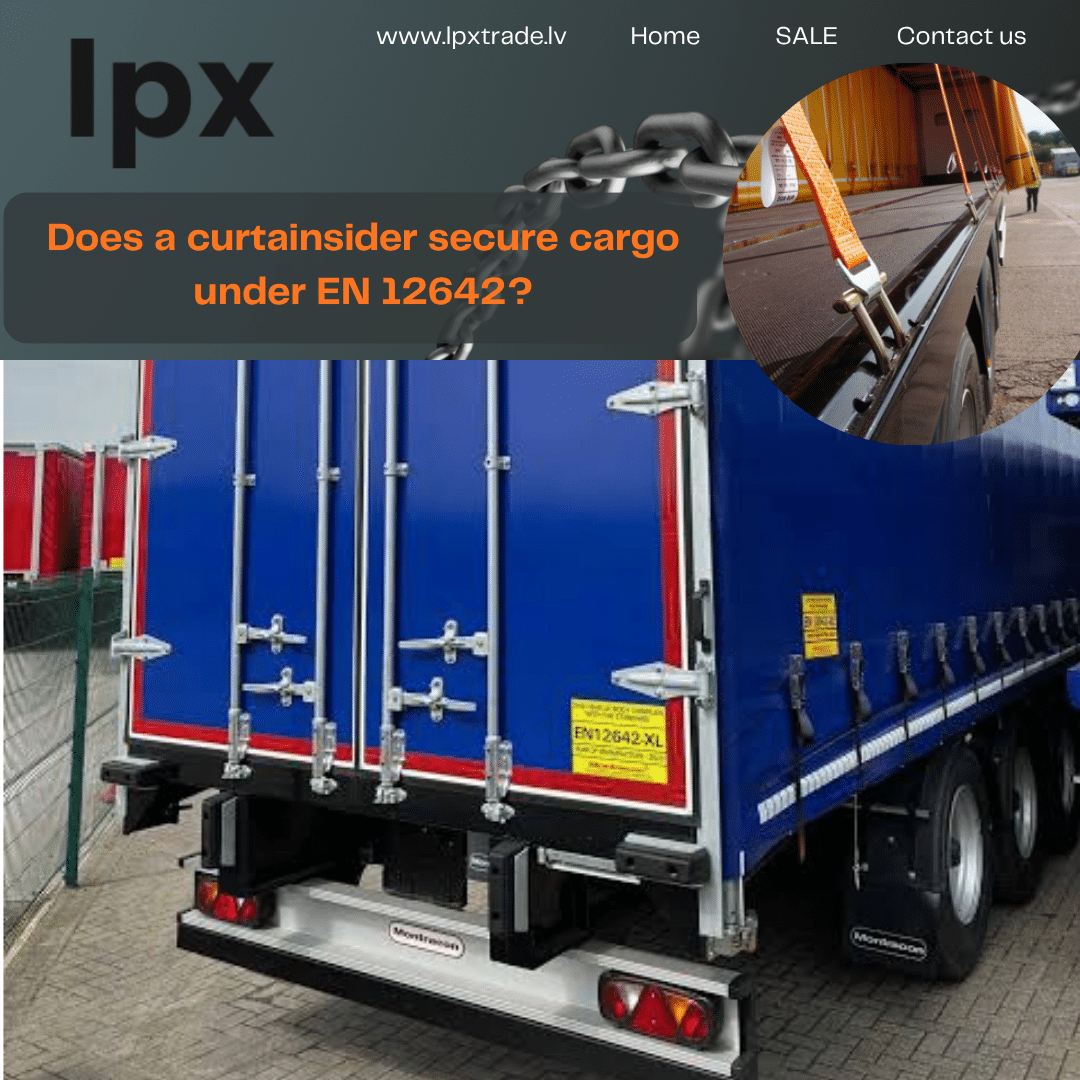
Does a curtainsider secure cargo under EN 12642?
EN 12642 Code XL is a reinforced body. With form-fit loading, it can partly replace lashing straps. A standard curtain-sided (Code L) trailer, however, holds almost nothing. The curtain is weather protection only. Therefore, a securing calculation counts its side strength as zero. You may credit the body walls towards restraint only in two cases: a certified Code XL body, and gap-free loading within tolerance. Otherwise, you must lash the cargo to EN 12195-1 — 0.8 g forward, and 0.5 g sideways and rearward.
Many drivers and logistics managers believe a myth. They assume that cargo standing under a curtain is already “secured”. On the road, however, this belief leads to fines and accidents. In fact, EN 12642:2016 splits bodies into two classes: standard Code L and reinforced Code XL. Moreover, it defines exactly how much load each wall can hold. So let us walk through the norms, the figures, and the point where straps stop being optional.
Code L vs Code XL: what do the figures say?
In EN 12642, each wall’s strength is a fraction of the payload P. Here, P is the technically permissible cargo mass. You then calculate the force as “fraction × P × 9.81”. In addition, the requirements differ across three elements: the front wall (headboard), the side walls, and the rear wall.
| Body element | Code L (standard) | Code XL (reinforced) |
|---|---|---|
| Front wall (headboard) | 0.4 × P (max 50 kN ≈ 5,000 daN) | 0.5 × P (no upper limit) |
| Side walls | 0.3 × P (rigid body only; ≈ 0 on a curtainsider) | 0.4 × P |
| Rear wall | 0.25 × P (max 3.1 t ≈ 3,100 daN) | 0.3 × P |
Next, consider the securing itself. Here EN 12195-1 sets the baseline. The restraint system must withstand 0.8 g forward, and 0.5 g sideways and rearward. Friction, of course, reduces the net force. During testing, a Code XL body may deform elastically by up to 300 mm. However, permanent deformation must stay below 20 mm. Finally, you may credit only the forces that the test actually verifies.
| Element | Code L | Code XL |
|---|---|---|
| Front wall | ≈ 5,000 daN (50 kN cap) | ≈ 11,772 daN |
| Side walls | ≈ 7,063 daN (rigid body) / ≈ 0 (curtainsider) | ≈ 9,418 daN |
| Rear wall | ≈ 3,100 daN (3.1 t cap) | ≈ 7,063 daN |
Why doesn’t a standard curtain count as cargo restraint?
Here is the key nuance. The side curtain of a standard curtainsider is not a structural element. In Code L, the 0.3 P figure applies to a rigid side wall — a box or dropside body. On a curtain-sided Code L trailer, by contrast, the calculation takes the side wall as zero. After all, the curtain only keeps out rain and wind. It cannot hold tonnes of cargo during hard braking or a lane change.
So how does a curtainsider’s side wall ever count? Only through Code XL certification. This means reinforced posts, a reinforced curtain, and a body that a test house checks as a single unit. It also means a valid certificate from TÜV, DEKRA or VCA. Then, and only then, the wall gives up to 0.4 P of lateral restraint. Watch one condition, though: a damaged curtain or wall can void the certificate after an incident.
When does Code XL replace straps — and when not?
Even a reinforced body counts only with form-fit (positive-fit) loading. Specifically, four conditions apply:
- the cargo sits tight against the front wall;
- side gaps stay within tolerance (typically ≤ 4 cm each side; EU/UK enforcement accepts up to 8 cm at the sides);
- you distribute the load evenly across the floor and up to 75% of the wall height;
- the certificate stays valid, and the body and curtain stay undamaged.
What if even one condition fails? For example, gaps appear, the load stands off the front wall, the body is only Code L, or the certificate is missing. In that case, the wall strength does not count. Then you must lash the cargo in full to EN 12195-1. In practice, therefore, the safest crews combine both methods. They load form-fit, and they add lashing straps, shoring bars or anti-slip mats wherever gaps remain.
Frequently asked questions (FAQ)
What is EN 12642 Code XL?
EN 12642 Code XL is a European standard for a reinforced truck or trailer body. Specifically, it sets the minimum strength of the front, side and rear walls at 0.5, 0.4 and 0.3 of the payload. With form-fit loading, such a body can partly replace lashing straps. A standard Code L body, however, cannot.
How does Code XL differ from Code L?
Code L is a standard body. Its front wall holds 0.4 P (max 50 kN), the side walls 0.3 P, and the rear wall 0.25 P (max 3.1 t). Code XL, by contrast, is reinforced: 0.5 P, 0.4 P and 0.3 P, without those hard caps and with a mandatory certificate. On a Code L curtainsider, moreover, the side wall barely counts.
Do you still need to lash cargo in a Code XL trailer?
Not always. First, the trailer needs a valid Code XL certificate. Second, you must load the cargo form-fit, with gaps within tolerance. Then the walls give enough lateral and longitudinal restraint. However, if gaps appear, the load stands off the front wall, or the certificate is missing, lash it fully to EN 12195-1.
Does the curtain hold cargo on a standard curtainsider?
No. On a standard curtainsider (Code L), the curtain is weather protection, not a securing element. Therefore its side strength counts as zero. Instead, you must fully restrain such cargo with lashing straps, shoring bars or anti-slip mats. The curtain alone simply will not hold it during braking or a manoeuvre.
What is form-fit (positive-fit) loading?
Form-fit (positive-fit) loading means the cargo sits tight against the front and side walls, with no gaps beyond tolerance. Typically that means ≤ 4 cm each side under the standard, though EU enforcement accepts up to 8 cm. Only then does a Code XL body’s strength count towards load restraint.
Is a Code XL certificate mandatory, and what if cargo is unsecured?
You need a Code XL certificate to rely on the body’s strength instead of straps. Without it, an inspector simply treats the body as standard. Moreover, loose or poorly loaded cargo in the EU draws fines of up to €5,000 per check. Inspectors can also hold the vehicle until you fix the fault.
Related on the LPX Trade blog: the 5 cargo securing methods, how many straps a pallet needs, and lashing chains vs straps.
Author: the LPX Trade expert team — a supplier of certified cargo-securing equipment (lashing straps, chains, slings, seals) for the European market, with over 20 years in Baltic logistics.
Updated: 13 September 2026.
Sources: EN 12642:2016 (Code L / Code XL body strength); EN 12195-1 (cargo securing calculation); IRU “International Guidelines on Safe Load Securing for Road Transport”; IMO/ILO/UNECE CTU Code; DVSA/DfT “Safety of Loads on Vehicles — Code of Practice”.