
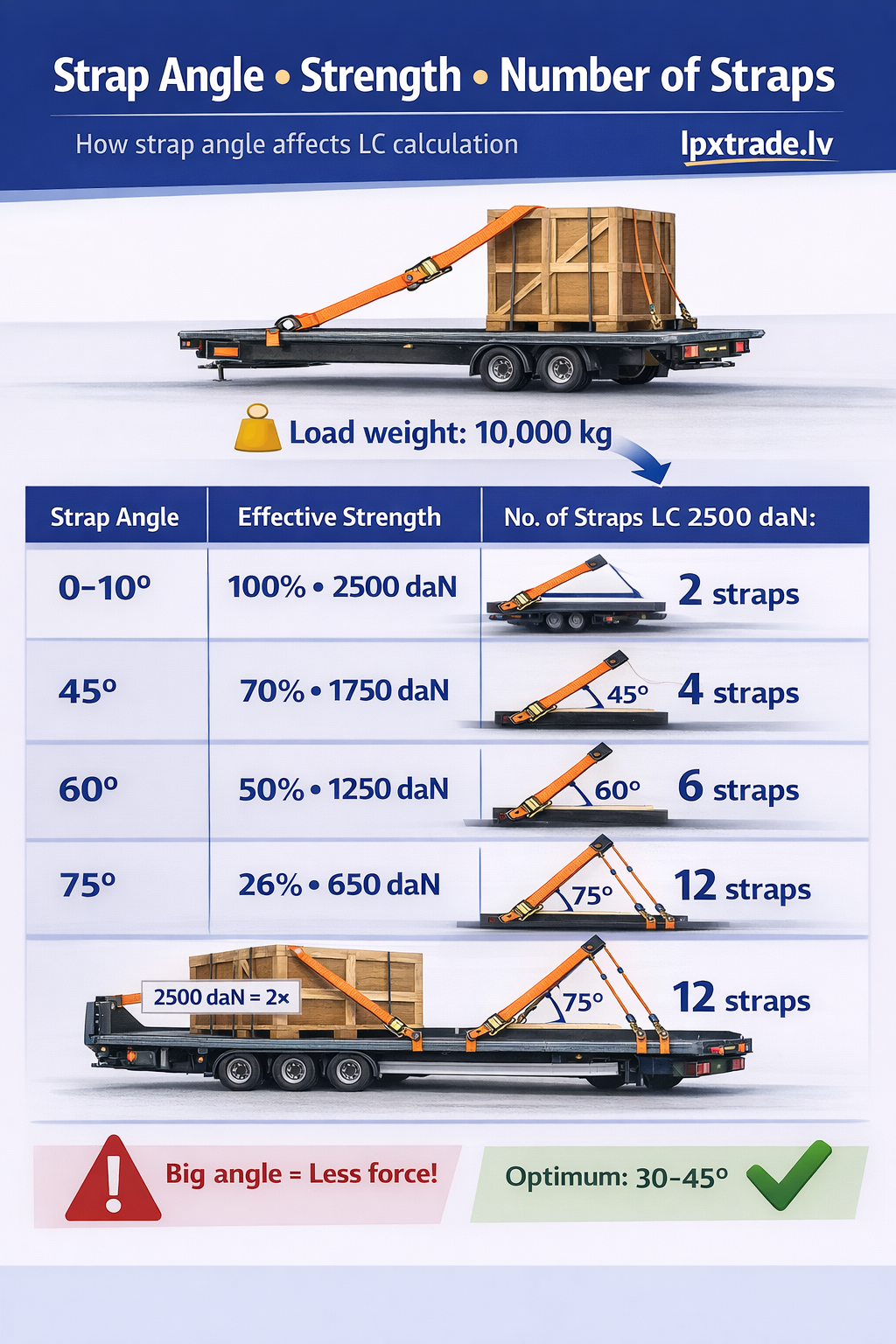
How do lashing angles affect LC?
The cargo lashing angle decides how much of a strap’s rated LC actually holds the load — and the rule flips depending on the method. For direct (diagonal) lashing, the useful horizontal restraint = LC × cos α (α measured from the deck), so a flatter strap around 30–45° holds more against fore-and-aft movement; at 60° a 2,500 daN strap gives only 1,250 daN. For tie-down (top-over) lashing it is the opposite: the downforce follows sin α, so you want the strap near vertical, 75–90°. Getting the angle wrong is the single most common LC mistake — and the one inspectors check first.
Cargo securing is not done “by eye” or “the way we always have”. It is physics, standards and calculation. In 30 years around logistics and securing equipment, we have seen most accidents, fines and damaged loads trace back to one thing: LC worked out from the label alone, with the lashing angle ignored. This guide explains what LC really is, how the angle changes the useful force for each method, the formulas, and how anti-slip mats cut the number of straps.
What is LC in cargo securing?
LC (Lashing Capacity) is the maximum working load of a strap or chain in a straight pull — for example, LC 2,500 daN ≈ 2,500 kg of securing force. However, the LC on the label is not the real securing force once the strap sits at an angle. To turn LC into a number of straps for a tie-down load, use our 2-minute LC calculation; this article focuses on the angle.
How does the lashing angle change the force? Tie-down vs direct
This is where most confusion starts, because the two methods pull in opposite directions — literally. Tie-down presses the load down (friction), so it wants a steep, near-vertical strap. Direct lashing holds the load in place along the deck, so it wants a flatter strap. In short:
| Method | Useful force | Best angle (from deck) | Rule of thumb |
|---|---|---|---|
| Tie-down (top-over) | Downforce ∝ LC/STF × sin α | 75–90° (near vertical) | Steeper = more grip |
| Direct (diagonal) | Horizontal ∝ LC × cos α | 30–45° (flatter) | Flatter = more horizontal hold |
So the “keep it near vertical” advice for tie-down and the “keep it flat” advice for direct lashing are both correct — for their own method. The tie-down (sin) side is covered in the strap-count guide; below we work through the direct-lashing (cos) side.
Direct lashing: how the angle cuts the horizontal force
For direct (diagonal) lashing, the effective horizontal restraint is F_eff = LC × cos α. Therefore the steeper the strap, the less it resists fore-and-aft movement:
| Strap angle to deck | Horizontal efficiency | Example: LC 2,500 daN |
|---|---|---|
| 0–10° | ≈ 100% | ≈ 2,500 daN |
| 30° | ≈ 87% | ≈ 2,165 daN |
| 45° | ≈ 70% | ≈ 1,765 daN |
| 60° | ≈ 50% | 1,250 daN |
| 75° | ≈ 26% | ≈ 650 daN |
A very flat strap holds the most horizontally, but in practice you keep direct lashings in the 30–45° band so they also carry some down-force and stay clear of obstructions. For heavy, rigid loads, direct lashing with lashing chains is the usual choice.
The securing-force formula (EN 12195-1)
Whatever the method, you first work out the force the system must resist. Under EN 12195-1 that is F = m × g × c, which in daily practice simplifies to:
The standard coefficients are 0.8 forward (the governing case, emergency braking), and 0.5 sideways and rearward. For a 10,000 kg load in the forward direction:
Worked example: number of direct lashings at an angle
Take that 8,000 daN requirement and straps of LC 2,500 daN set at 60° (a steep, non-ideal angle for direct lashing):
Straps needed = 8,000 / 1,250 = 6.4 → 7 straps
Flatten those straps toward 30–45° and each one does far more work, so you need fewer of them. That is the whole point of watching the angle.
How do anti-slip mats cut the number of straps?
The other big lever is friction. Without mats the friction coefficient is low — metal on wood ≈ 0.2, a pallet on the floor ≈ 0.3 — but a certified anti-slip mat raises it to 0.6–0.8. As a result, a large share of the securing force is carried by friction, and the straps mainly stabilise. For a 10,000 kg load, going from μ 0.3 to 0.6 frees up about 3,000 daN — roughly two to three straps of LC 2,500 daN. See the full method in our guide to anti-slip mats for cargo.
Common LC calculation mistakes
- Reading the force straight off the strap label, ignoring the angle
- Using the wrong trig for the method (sin for tie-down, cos for direct)
- Near-vertical direct lashings that give almost no horizontal hold
- No anti-slip mats, so the straps carry everything
- “Habit-based” securing with no calculation and no safety margin
Expert recommendations
- Set the angle to the method: tie-down near vertical (75–90°), direct lashing flatter (30–45°).
- Combine blocking and lashing rather than relying on straps alone.
- Always use anti-slip mats — they are part of the system, not an accessory.
- Add a 20–30% safety reserve.
- Secure heavy, rigid cargo with direct lashing to rated lashing points, and put the angle check on your pre-departure checklist.
- If in doubt, calculate — an ignored angle is the number-one fine at inspection.
Right angle, right kit. LPX Trade supplies LC-marked straps, certified anti-slip mats and Grade 80 chains — so you can hit the numbers rather than guess them. EN 12195, DoC available on request.
FAQ: LC calculation and lashing angles
How does the lashing angle affect the securing force?
It depends on the method. For direct (diagonal) lashing the useful horizontal force is LC × cos α, so flatter straps (30–45°) hold more against fore-and-aft movement. For tie-down lashing the downforce is LC/STF × sin α, so near-vertical straps (75–90°) press the load down best. Using the wrong one is a common mistake.
What is the effective LC of a strap at 60°?
For direct lashing, a 2,500 daN strap at 60° to the deck gives 2,500 × cos 60° = 1,250 daN of horizontal restraint — half its rating. At 75° it drops to about 650 daN. This is why steep direct lashings are inefficient and why the angle must go into the calculation.
What acceleration coefficients does EN 12195-1 use?
The securing force is F = cargo weight × acceleration coefficient. The standard coefficients are 0.8 forward (emergency braking, the governing case) and 0.5 sideways and rearward. For a 10,000 kg load forward, that is 10,000 × 0.8 = 8,000 daN minimum.
How many straps do I need for a 10,000 kg load?
First find the required force (10,000 × 0.8 = 8,000 daN forward). Then divide by the effective force per strap. With LC 2,500 daN straps at 60° (1,250 daN each) you need about seven; flatten them to 30–45° or add anti-slip mats and you need far fewer.
How much do anti-slip mats reduce the number of straps?
Raising friction from μ ≈ 0.3 to 0.6 shifts a large part of the force onto friction — about 3,000 daN for a 10,000 kg load, or roughly two to three straps of LC 2,500 daN. Mats are one of the cheapest ways to bring a difficult calculation back under control.
Author: LPX Trade Editorial Team — a supplier of EN 12195 cargo securing equipment, drawing on 30 years of logistics practice.
Last updated: 2 August 2026.
Sources: EN 12195-1:2010 (calculation of securing forces); EN 12195-2 (webbing lashings, LC/STF); VDI 2700 (securing of loads on road vehicles, friction values).