
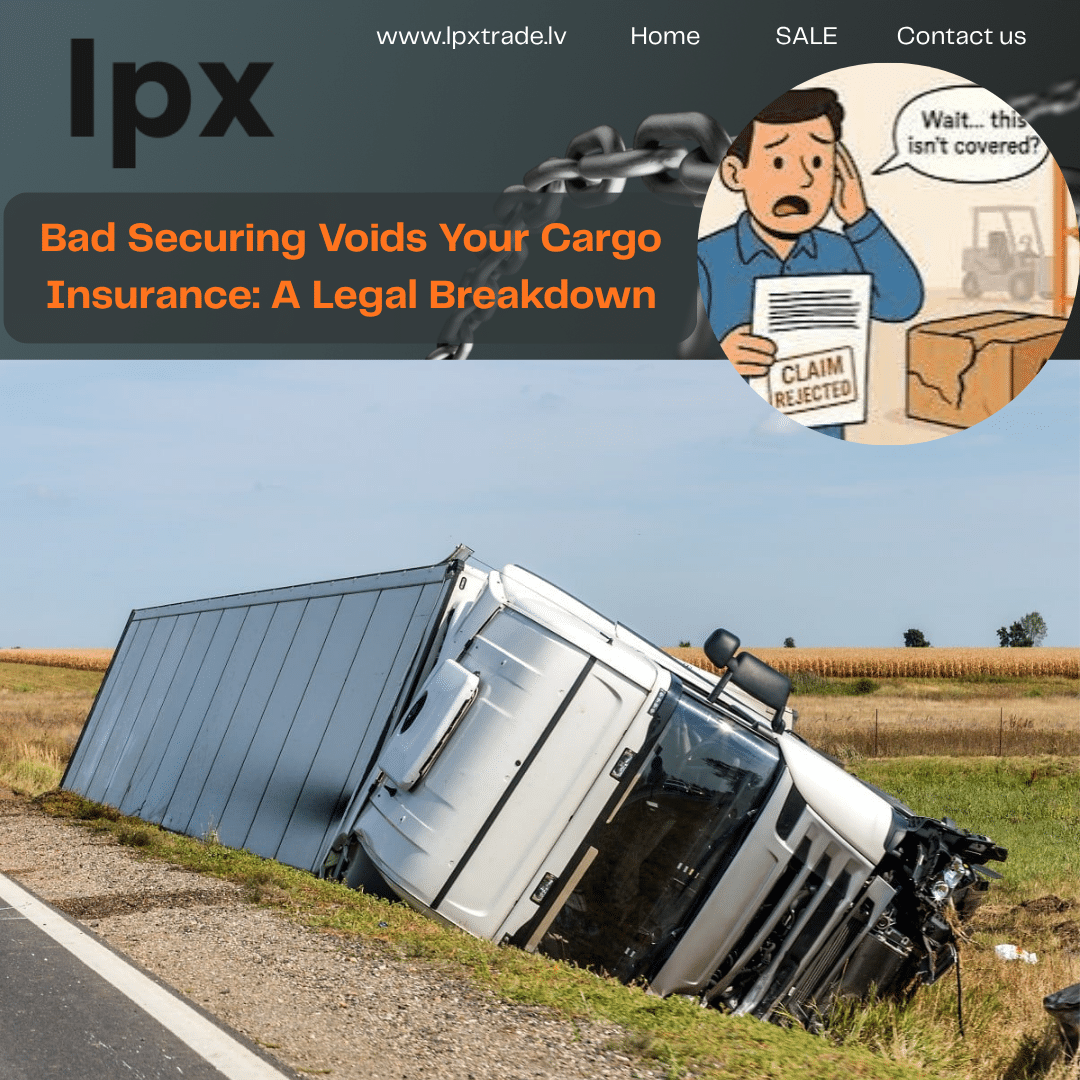
Can bad securing really void your cargo insurance?
Yes — cargo insurance can fail to pay out when someone secured a load improperly, and it hits from two sides at once. A goods policy lets the insurer decline under the insufficiency-of-packing-and-preparation exclusion (Institute Cargo Clauses A, clause 4.3), while under the CMR Convention gross negligence in securing strips the carrier of the 8.33 SDR/kg liability cap (Article 29) — a loss its liability policy usually won’t cover either. In short, “but it’s all insured” is no guarantee of payment. Below we break down exactly where the cover tears, and how correct securing keeps it intact.
This picks up where our breakdown of what damaged cargo really costs left off: there we showed that CMR compensation is capped by weight, not value. Here we go one step further — to the scenario where there’s no payout at all.
Two different policies that constantly get confused
The first thing to grasp: “insurance on the cargo” isn’t one product but two separate policies with different logic. Which one responds — or declines — decides who ultimately pays.
| Aspect | Cargo insurance (goods) | Carrier liability insurance (CMR) |
|---|---|---|
| Who it protects | The cargo owner | The carrier |
| What it covers | The value of the goods (per the policy) | The carrier’s CMR liability |
| Payout ceiling | The sum insured in the contract | 8.33 SDR/kg (CMR Article 23) |
| Where securing breaks it | Insufficient preparation/stowage exclusion (ICC A, clause 4.3) | Gross negligence removes the cap (CMR Article 29) |
When cargo insurance won’t respond
Around the world, goods cover rests on the Institute Cargo Clauses (ICC). Even the widest “A” version (the “all risks” equivalent) still carries a list of exclusions — and one of them speaks directly to securing.
Clause 4.3 of ICC (A) excludes loss caused by insufficiency or unsuitability of packing or preparation of the goods to withstand the ordinary incidents of transit, where the assured or their employees carried out that preparation, or where it happened before the insurance attached. The key nuance: in these clauses, “packing” is deemed to include stowage. So a load that someone stowed and secured improperly gives a live ground for declining the claim.
There’s a second exclusion too — wilful misconduct of the assured (clause 4.1). Knowingly sending a load out with no proper securing, on a hope and a prayer, walks straight into it. It matters, however, that the burden of proof sits with the insurer: it must show that the insufficient preparation proximately caused the loss. But if the goods travelled with no straps, mats or edge protectors, that isn’t hard to demonstrate.
Why the carrier can be left unprotected under CMR
On the carrier’s side the logic differs; however, the result rhymes. Under CMR Article 17 the carrier answers for damage to the goods, and Article 23 caps the payout at 8.33 SDR per kilogram — the familiar “weight trap.”
But then there’s Article 29. If the carrier’s wilful misconduct — or a default treated as equivalent to it (gross negligence) — causes the damage, the carrier loses the right to limit liability. The 8.33 SDR/kg cap vanishes, and they answer for the full value of the goods. Habitually carrying loads without proper securing is exactly what courts in several jurisdictions treat as gross negligence.
How securing to EN 12195 keeps the payout alive
The good news: all of this is manageable. “Proper securing” isn’t an abstraction — it’s a measurable requirement. The EN 12195 standard defines it: the calculation of forces and the number of lashings (EN 12195-1), textile straps (EN 12195-2) and chains (EN 12195-3). And at roadside checks under Directive 2014/47/EU, inspectors judge the securing against exactly these criteria.
Here’s what that buys you on the insurance side:
- It removes the ground for refusal. When the load is secured to EN 12195, the insurer’s “insufficient preparation” argument falls apart.
- It shields you from CMR Article 29. Securing to the standard isn’t “gross negligence” — it’s a duty performed. The liability cap stays in force.
- It gives you evidence. Certified equipment with a marked LC, loading photos and a calculation are what settle a dispute in your favour.
That’s why securing gear isn’t a line to trim — it’s part of your insurance cover. Mistakes here are expensive: just as a badly seated eye bolt or an unlocked turnbuckle can undo the whole restraint, a “saved” set of straps can wipe out the payout.
From the breakdown to the practical. Certified straps, chains and tensioners to EN 12195 with a marked LC are in the LPX Trade catalogue: ratchet straps and chains and binders.
FAQ: cargo securing and insurance
Can an insurer refuse a claim over bad cargo securing?
Yes. Under Institute Cargo Clauses (A), clause 4.3, the insurer may decline if the loss was caused by insufficient packing or preparation of the goods, which includes their stowage. If the load travelled without proper securing, that’s a direct ground for refusal. The burden of proving the cause, however, rests with the insurer.
How does cargo insurance differ from CMR insurance?
Cargo insurance protects the goods owner and covers their value up to the sum insured. Carrier liability (CMR) insurance protects the carrier, and the CMR cap of 8.33 SDR per kilogram applies. They are two different policies, and securing affects both: the first through the preparation exclusion, the second through CMR Article 29.
What is CMR Article 29 in plain terms?
Article 29 of the CMR Convention strips the carrier of the right to limit liability when wilful misconduct — or a default treated as equivalent to it — causes the damage. In plain terms, the 8.33 SDR/kg cap disappears and the carrier answers for the full value of the goods. Habitually securing loads improperly can count as gross negligence.
Does a carrier’s policy cover gross negligence?
As a rule, no. Carrier liability policies usually exclude losses from wilful misconduct and gross negligence. So when CMR Article 29 removes the liability cap, the carrier risks being left with no cover and paying the full amount of the damage out of pocket.
How does securing to EN 12195 protect against refusal?
EN 12195 sets measurable requirements for securing: the calculation of forces and the number and strength of lashings. So a load secured to the standard denies the insurer its “insufficient preparation” argument, and it doesn’t fall under gross negligence in CMR terms. Certified equipment with a marked LC and loading photos serve as evidence in a dispute.
Who is responsible for securing — the driver or the shipper?
Responsibility is shared. Under Directive 2014/47/EU, a roadside inspector can sanction the driver, the carrier and the shipper who loaded the vehicle. So on the insurance side, a securing failure touches everyone in the chain, not just the driver.
Author: LPX Trade Expert Editorial Team — a supplier of EN 12195 cargo securing equipment. This guide draws on standard insurance clauses, the CMR Convention and EU legislation.
Last updated: 16 August 2026.
Sources: Institute Cargo Clauses (A) 2009 (exclusions 4.1 and 4.3); CMR Convention, Articles 17, 23 and 29 (carrier liability and removal of the cap); Directive 2014/47/EU (roadside technical inspection and cargo securing); EN 12195-1:2010 (securing calculation).
This article is for information only and is not legal or insurance advice: payout depends on the specific policy, the carriage contract and the applicable law. Certified securing equipment to EN 12195 is in the catalogue at lpxtrade.lv.