
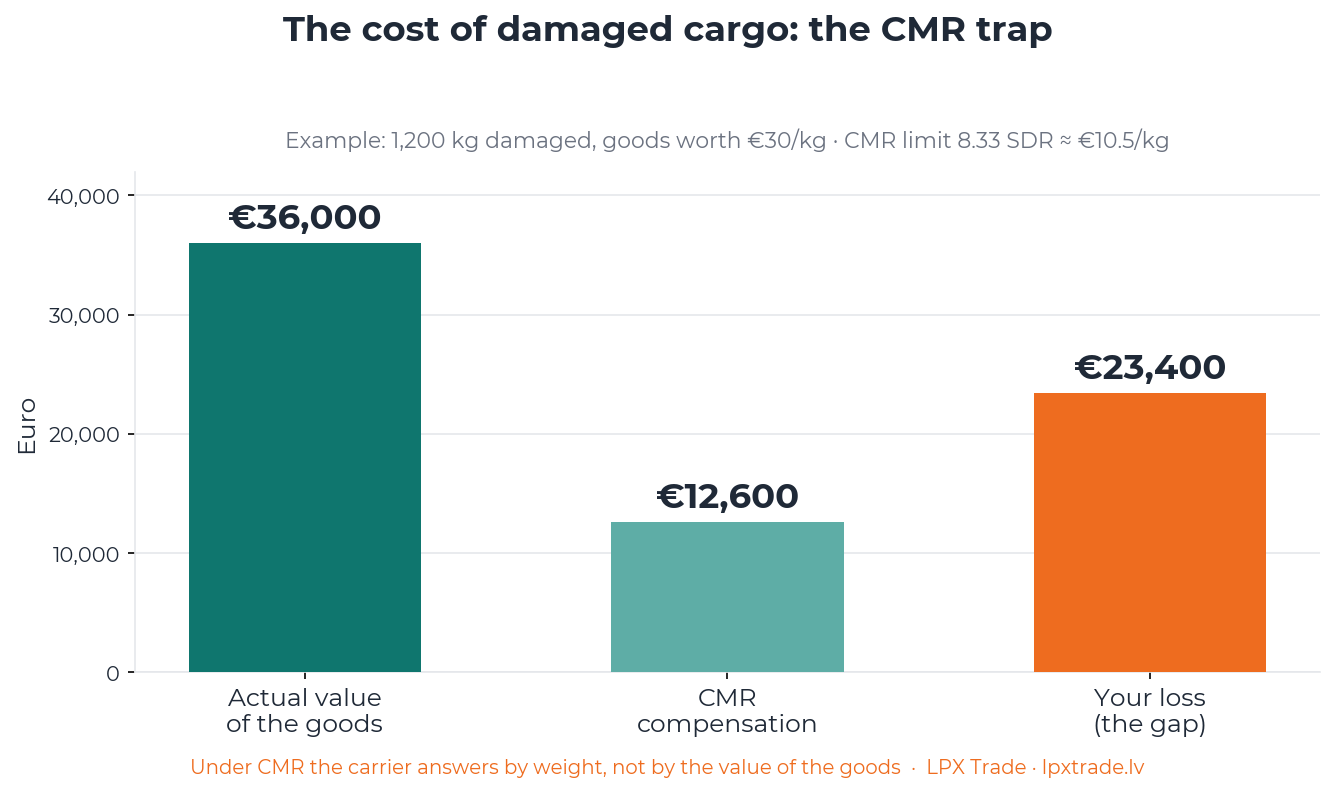
What is the real cost of damaged cargo?
The cost of damaged cargo almost always exceeds what the carrier pays back, because the CMR Convention caps carrier liability at 8.33 SDR per kilogram — roughly €10–11 per kg of weight, not the actual price of the goods. So if your cargo is worth more than €11 per kilogram, the cargo owner covers the difference. On top of that come the securing fine, vehicle downtime, re-delivery and a higher insurance premium. In the worked example below, one incident costs €24,800 — dozens of times more than a full year of securing equipment.
At first, lashing straps and chains look like an easy line to trim from the budget. However, the arithmetic flips completely the moment the first incident happens. Let’s break the cost of damaged cargo down into its parts, using real limits and real numbers.
What makes up the cost of damaged cargo?
At first glance, cargo owners usually count only the ruined goods themselves. In practice, though, the bill has at least five parts — and the biggest one is precisely what carrier liability does not cover.
| Component | What it is | Who pays in practice |
|---|---|---|
| Uncovered value of the goods | The gap between the real price of the cargo and the CMR cap (8.33 SDR/kg) | The cargo owner |
| Fine for improper securing | A sanction at a roadside check under Directive 2014/47/EU | Driver, carrier and loader — liability is shared |
| Vehicle downtime | The truck sits through the claim and the reload instead of running | The carrier |
| Re-delivery and repacking | A new run, pallets, packaging and warehouse labour | The shipper or the carrier |
| Higher premium and lost contract | The insurer reprices after a claim; the client may walk away | The carrier |
The CMR trap: carriers pay by weight, not by value
Article 23 of the CMR Convention caps compensation at 8.33 SDR per kilogram of missing or damaged gross weight. SDR is the IMF unit of account with a floating rate, so in practice this works out to roughly €10–11 per kilogram. The logic matters here, because the carrier answers for the weight of the cargo rather than for its commercial value.
Therefore the gap grows enormous for light, expensive freight — electronics, tools, spare parts, instruments. A kilogram of laptops can be worth €200, yet the payout stays at the same €10–11. You can only break that ceiling in two ways: declare the value of the goods in the consignment note under Article 24 (for an agreed surcharge), or prove wilful misconduct or gross negligence by the carrier under Article 29.
Worked example: the cost of damaged cargo on a 4,000 kg load
So let’s take a typical groupage run. The conditions: 4,000 kg of cargo worth €120,000 (that is €30 per kg), and 30% of it — 1,200 kg — shifts and gets damaged in transit. For the CMR cap, meanwhile, we use €10.5 per kg.
| Line | Calculation | Amount |
|---|---|---|
| Actual value of the damaged goods | 1,200 kg × €30 | €36,000 |
| Compensation under CMR | 1,200 kg × €10.5 | −€12,600 |
| Uncovered loss | the difference | €23,400 |
| Vehicle downtime | 2 days × €400 | €800 |
| Repacking and re-delivery | — | €600 |
| Direct losses from the incident | — | €24,800 |
And that still leaves out the fine. At a roadside check in the EU, improper securing carries its own penalty, and the amounts reach up to €5,000. Therefore, with a fine included, the bill approaches €30,000. The slow losses don’t appear here either — the repriced policy and the risk of losing a contract once the claim is settled.
Why this concerns everyone in the chain. Directive 2014/47/EU shares responsibility for cargo securing: an inspector can sanction the driver, the carrier and the shipper who loaded the vehicle. So you cannot simply push it all onto the driver.
A year of securing gear vs one incident
Now for the other side of the equation — what it costs to equip one semi-trailer properly for a year. Here is an indicative kit for a standard curtainsider:
| Item | Quantity | Indicative cost |
|---|---|---|
| Ratchet lashing straps (LC 2500 daN, 5 m) | 20 pcs | €240 |
| Lashing chains with hooks (8 mm) | 4 pcs | €220 |
| Load binders / turnbuckles | 2 pcs | €70 |
| Anti-slip mats | set | €120 |
| Edge protectors | 20 pcs | €60 |
| Securing kit for a year | — | ≈ €710 |
The comparison speaks for itself: €24,800 against €710 — one incident costs roughly 35 times a year’s worth of securing gear. Even if you double the kit and halve the incident, the ratio still argues against cutting corners. Meanwhile, the European Commission estimates that up to 25% of truck accidents trace back to inadequate cargo securing, and around 40% of inspected vehicles run with poor securing or none at all.
To size the kit correctly rather than guess, use our 2-minute LC calculation guide. For a real case where the right gear prevented exactly this kind of loss, see how proper lashing saved a logistics company thousands.
The figures above form an illustrative calculation with stated assumptions, not a statistic. So plug in your own weight, cargo value and rates — the logic stays the same.
Equip the trailer for the price of avoiding one claim. EN 12195 cargo securing equipment with LC marking, TÜV SÜD tested. Declaration of Conformity available on request.
FAQ: the cost of damaged cargo and compensation
What does one damaged load actually cost?
The cost of damaged cargo combines the uncovered value of the goods, the fine, downtime, re-delivery and a higher premium. For example, with 4,000 kg worth €120,000 and 30% damage, direct losses run to about €24,800 — of which €23,400 is simply the gap between the real price and the CMR cap.
How much does a carrier pay under CMR for damaged cargo?
Under Article 23 of the CMR Convention, compensation is capped at 8.33 SDR per kilogram of damaged or missing weight — roughly €10–11 per kg at current rates. Because the carrier answers by weight rather than by commercial value, the payout covers only part of the loss on expensive goods.
What does 8.33 SDR per kilogram mean?
SDR (Special Drawing Rights) is the International Monetary Fund’s unit of account, and its rate floats. Article 23 of the CMR Convention sets the cap at 8.33 SDR per kilogram, which converts to about €10–11 per kg. In short, that figure is the ceiling on carrier liability for damaged or lost cargo.
Does CMR insurance cover the full value of the goods?
No. CMR insurance protects the carrier’s liability up to 8.33 SDR per kg, rather than the commercial value of the freight. So if your cargo exceeds €10–11 per kilogram, the owner carries the difference. Therefore, for full protection you need a separate all-risk goods policy, or a declared value in the consignment note under Article 24.
Who is responsible for improper cargo securing?
Responsibility is shared. Under Directive 2014/47/EU, a roadside inspector can sanction the driver, the carrier and the shipper who loaded the vehicle. Therefore correct securing belongs not only to the driver, but also to the warehouse that built the load.
How does a year of securing gear compare with one incident?
First, an indicative securing kit for one semi-trailer — straps, chains, binders, anti-slip mats and edge protectors — costs about €710 a year. The incident in the calculation above costs roughly €24,800, so it runs about 35 times more than the annual kit.
Author: LPX Trade Editorial Team — a supplier of EN 12195 cargo securing equipment. The team based this guide on EU legislation and on roadside-inspection practice.
Last updated: 2 August 2026.
Sources: CMR Convention, Articles 23, 24 and 29 (the 8.33 SDR per kg cap); Directive 2014/47/EU (roadside technical inspection and cargo securing); Cargo securing for road transport — European best practice guidelines (European Commission); EN 12195-1:2010.
This article is for information only and does not constitute legal advice: compensation depends on the carriage contract and the policy.