
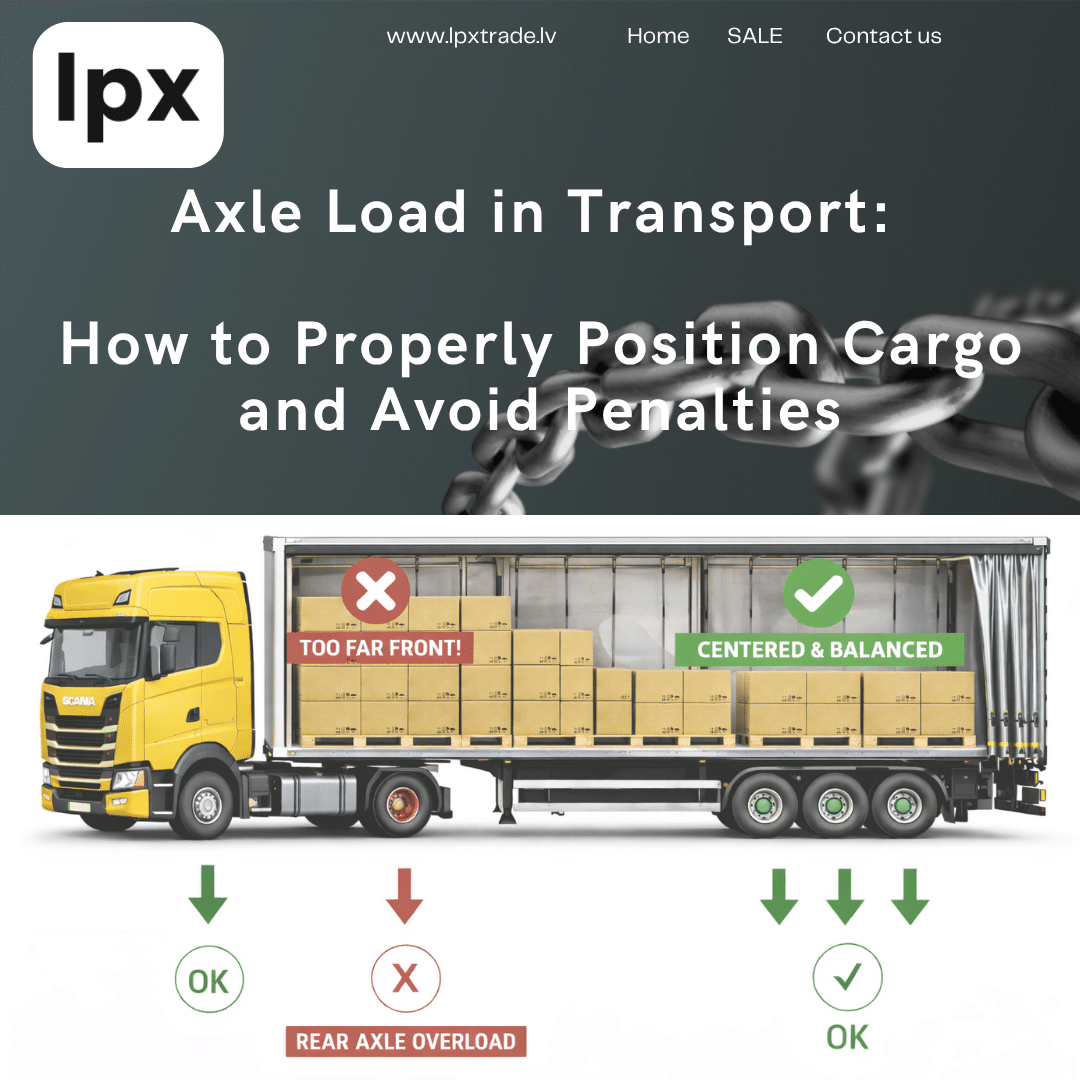
How should you distribute cargo weight across the axles?
Good cargo weight distribution means placing the heaviest items low, centred, and over or between the axles, so that no single axle exceeds its limit even when the total weight is legal. Because position — not just total mass — decides how much each axle carries, a compliant 40-tonne truck can still fail on one overloaded axle. So spread the weight along the trailer, keep the centre of gravity low and central, then secure it. The EU limits you must stay inside are 10 t on a single non-driven axle, 11.5 t on the driven axle, and 40 t gross (44 t in intermodal transport).
This guide is about how to load so the weight lands right; for the full ceiling values and the tyre and fine consequences, see our companion article on axle load and EU limits. Below: why distribution beats total weight, how position moves the axle load, where to place heavy cargo, the limits to respect and how to check before you leave.
Why does weight distribution matter more than total weight?
Drivers and loaders usually watch the gross weight and stop there. In practice, though, you hit the axle limit long before the total limit, and an inspector weighs each axle separately. Therefore a truck can sit at a perfectly legal 39 tonnes and still be fined because one axle is over. On top of the fine, an overloaded axle wears its tyres faster, lengthens the braking distance and overstresses the suspension.
How does cargo position change the axle load?
An articulated truck works like a lever. The further the cargo’s centre of gravity sits from an axle group, the more it loads the other end. Move mass towards the rear and the trailer bogie takes it; move it towards the front and the drive axle and kingpin take it. As a result, shifting one pallet a metre can change an axle reading by hundreds of kilograms without changing the total weight at all.
Multi-drop routes make this worse. Because you usually unload from the back, the centre of gravity creeps forward as the run goes on, which quietly adds load to the drive axle even though the truck is getting lighter. So re-check distribution after big drops, not only at the first loading.
Where should you place heavy cargo on the trailer?
| Cargo | Where it goes | Why |
|---|---|---|
| Heaviest items | Low, and over or between the axles | Keeps the centre of gravity low and loads the axles evenly |
| Along the length | Spread the weight; don’t pile it all at the nose or the tail | Tail-heavy overloads the trailer bogie; nose-heavy overloads the drive axle and kingpin |
| Across the width | Centred on the centre line | Avoids left/right imbalance and reduces rollover risk |
| Light and fragile | On top of the heavy base | Protects the goods and keeps the centre of gravity low |
| Gaps between items | Fill or block them | Stops the load shifting and changing the distribution mid-route |
Once the weight sits right, lock it in place so it stays there. Filling voids with blocking and dunnage and then securing the load by the correct method keeps your careful distribution from unravelling on the first roundabout — see the 5 cargo securing methods.
What EU axle limits must the distribution stay within?
The axle limits are the same across the EU under Directive 96/53/EC. These are the headline figures for a standard 5-axle articulated combination:
| Axle or combination | Maximum weight |
|---|---|
| Single non-driven axle | 10 t |
| Driven axle | 11.5 t |
| Tri-axle semi-trailer bogie | ≈ 8 t per axle; group up to 24 t |
| Kingpin (5th wheel) load | typically ≈ 12 t |
| Gross weight, 5-axle articulated | 40 t (44 t intermodal; +1 t alt-fuel / zero-emission) |
Member states may allow more on their own roads, and some sections are posted lower (for example 8 t per axle). For the full breakdown and why overloading eats tyres, read our axle-load and EU-limits guide.
How do you check axle load before departure?
First, make a simple loading plan before the pallets go on, rather than fixing it at the weighbridge. Then verify the result: a weighbridge gives the total, an onboard weighing system reads each axle in real time, and a load-planning tool predicts axle loads from cargo positions before you load. Finally, once the distribution checks out, secure the load to the right rated capacity. A load that shifts in transit ruins both the distribution and the securing — the kind of failure we cost out in the cost of damaged cargo.
Lock in the distribution you just planned. Once the weight sits right, blocking, anti-slip mats and rated lashings keep it there. EN 12195 equipment, LC-marked, DoC available on request.
FAQ: cargo weight distribution and axle load
What is cargo weight distribution?
Cargo weight distribution is how the load’s mass is spread across the vehicle’s axles. It depends on where each item sits along and across the trailer, not only on the total weight. Correct distribution keeps every axle within its limit and the centre of gravity low and central.
Can you be fined if the total weight is legal but one axle is overloaded?
Yes. An inspector weighs each axle separately, so a truck within its gross limit can still be fined for a single overloaded axle. In fact you usually reach the axle limit before the total limit, which is why position matters as much as weight.
Where should the heaviest cargo go on a trailer?
Place the heaviest items low and over or between the axles, centred on the centre line. Spread weight along the length rather than piling it at the nose or tail, put light and fragile goods on top, and fill any gaps so the load cannot shift in transit.
What are the EU axle load limits?
Under Directive 96/53/EC the limits are 10 t on a single non-driven axle, 11.5 t on the driven axle, and 40 t gross for a 5-axle articulated combination — 44 t in intermodal transport. The kingpin load is typically capped around 12 t. Member states may allow more on their own roads.
How do you check axle load before leaving?
Make a loading plan first, then confirm it. A weighbridge gives the total, an onboard weighing system reads each axle in real time, and a load-planning tool predicts axle loads from cargo positions. Total-weight compliance does not guarantee axle compliance, so check the axles specifically.
Does multi-drop delivery affect weight distribution?
Yes. Because you usually unload from the rear, the centre of gravity moves forward as the run goes on, adding load to the drive axle even as the truck gets lighter. Therefore re-check the distribution after major drops, not only at the first loading point.
Author: LPX Trade Editorial Team — a supplier of EN 12195 cargo securing equipment, drawing on 30 years of logistics practice. The team based this guide on EU legislation and on day-to-day loading experience.
Last updated: 2 August 2026.
Sources: Directive 96/53/EC (authorised weights and dimensions, as amended by 2015/719); Cargo securing for road transport — European best practice guidelines (European Commission).
This article is for information only. Axle limits and permits vary by country and vehicle configuration; check national rules for your route.