
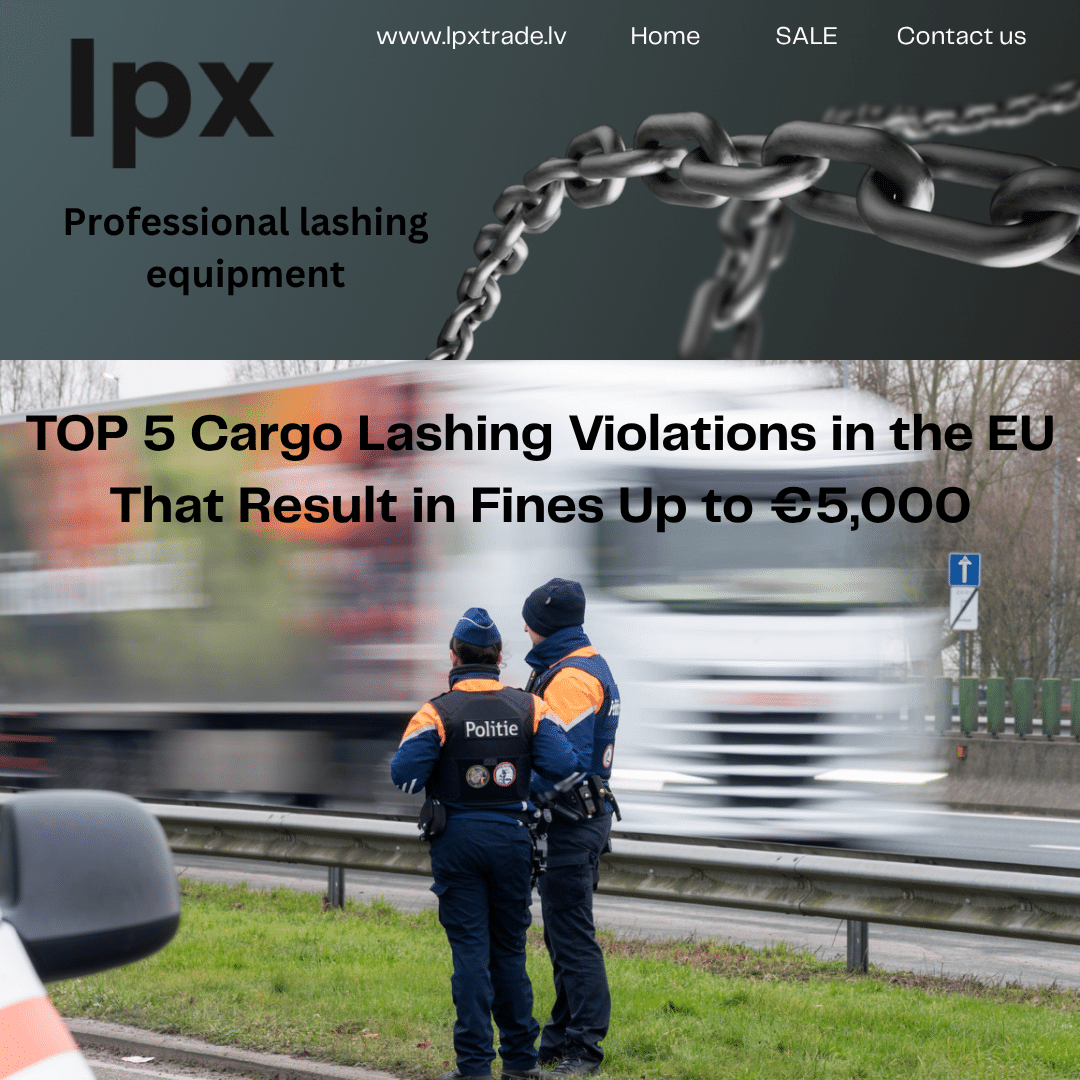
Krovinių tvirtinimo baudos ES
ES krovinių tvirtinimo baudos siekia €5000 už patikrą. Kas penktam sunkvežimiui rasta tvirtinimo pažeidimas. Penki dažniausiai nustatyti pažeidimai: nepakankama bendra tvirtinimo galia (kampas nepataisytas), pažeistos ar neženklinti tvirtinimo diržai, trūksta atitikties sertifikuojančios dokumentacijos, neteisingas krovinių tvirtinimo metodas ir nėra pakartotinos patikros po pirmo 50 km. Beveik pusėje šių atvejų problema būtų galėjusi būti išspręsta per dešimt minučių prieš išvažiavimą. Žemiau pateikiami penki pažeidimai su tikrais duomenimis, griežčiausios šalys ir kaip laikytis EN 12195 reikalavimų.
Tai nėra atskiras atvejis. Pasak Europos kelių saugumo observatorijos, vienas iš penkių sunkvežimių, sustabdytų ES, turi krovinių tvirtinimo pažeidimą. Šiame straipsnyje analizuojame penkis dažniausius pažeidimus, už kuriuos inspektoriai skiria baudas — su skaičiais, griežčiausiomis šalimis ir paprastais būdais, kaip likti atitinkančiam reikalavimams.
Kodėl ES inspektoriai tapo griežtesni?
Before 2020, lashing inspections in most EU countries were largely advisory: a warning, then on you go. That changed after stricter road-control directives and a series of accidents linked to unsecured cargo. Today Germany, the Netherlands, Austria and Belgium field specialist enforcement teams (BAG, NVWA and equivalents) trained specifically on lashing — and they carry tools: force gauges, angle meters and ultrasonic strap-defect detectors.
5 pažeidimai, dėl kurių dažniausiai baudžiama
Pažeidimas 1 — Nepakankama tvirtinimo galia
The most frequent and most costly violation. EN 12195-1 requires the total restraint force to counter inertia during braking, acceleration and cornering — at least 50% of cargo mass forward, and 25–30% sideways and rearward. The catch: many drivers add their straps’ nominal LC correctly but ignore the lashing angle. At 30° to the horizontal the effective force is only 50% of nominal; at 45°, about 70%. Inspectors check the angle correction specifically. Get the sum right with our 2 minučių LC skaičiavimas ir Kampų vadovas.
⚠ Bauda: €500–€5000 priklausomai nuo sunkumo ir šalies. Vokietijoje LC trūkumas virš 30% lemia automatinį draudimą tęsti.
✓ Kaip išvengti: Apskaičiuokite efektyvią keliamąją galią su realiaisiais kampais prieš išvykimą; jei kampas mažesnis nei 45°, pridėkite tvirtinimo taškus arba naudokite tvirtinimo diržas su didesne keliamąja galia.
Pažeidimas 2 — pažeista tvirtinimo įranga
A strap is a consumable. EN 12195-2 sets clear rejection criteria: cuts or abrasion deeper than 10% of the webbing, deformation and tears, illegible labelling, corroded buckles and ratchets, and chemical exposure. Crucially, inspectors also check the marking: if LC, STF or the conformity mark are not clearly readable, the strap counts as unusable regardless of its actual condition — so even a physically intact but worn strap earns a fine. The material and label colour matter too, as we cover in Polipropilenas vs poliesteris.
⚠ Bauda: €300–€2500 už vienetą — bauda už kiekvieną diržą
✓ Kaip išvengti: Patikrinkite kiekvieną tvirtinimo diržą prieš naudojimą, pakeiskite, jei nustatyti defektai, ir saugokite apsauginėse apvalkuose.
Pažeidimas 3 — Trūksta įrangos dokumentacijos
Tai nustebina vairuotojus, kurie yra tikri, kad viskas gerai. Ypač Prancūzijoje, Vokietijoje ir Austrijoje inspektorius gali pareikalavti pagrindinę dokumentaciją — Atitikties deklaraciją EN 12195-2 arba EN 12195-3 ir kartais naudojimo instrukcijas, o ne tik diržus. Partijos sertifikatas biure nepadeda kelyje; kelyje svarbu tik tai, kas fiziškai yra kabinoje.
⚠ Bauda: €250–€3 750. Prancūzijoje bauda už trūkstamą dokumentaciją gali būti skirta net jei krovinių tvirtinimas teisingas.
✓ Kaip išvengti: Saugokite atitikties deklaraciją visai įrangai. LPX Trade deklaracija įtraukta į kiekvieną produktą.
Pažeidimas 4 — netinkamas krovinių tvirtinimo metodas
EN 12195-1 apibrėžia kelis tvirtinimo metodus, kurie taikomi konkrečioms krovinio rūšims. Tvirtinimo juosta veikia tik tada, kai trinties koeficientas yra pakankamas — mediena ant plieno yra apie 0,3, mediena ant nuslydimo apsaugos kilimo apie 0,5. Tvirtinimo juostos naudojimas cilindrinėms krovoms, tokioms kaip vamzdžiai ar ritiniai, be sulaikymo — klasikinis pažeidimas; tokiems kroviniams reikalingas tiesiogas arba kilpinis tvirtinimas su sulaikymu. Pasirinkite metodą pagal 5 krovinių tvirtinimo metodai.
⚠ Bauda: €400–€2800. Neteisinga metodika laikoma sisteminę klaidą ir nustatomas draudimas iki pataisymo.
✓ Kaip išvengti: Prieš kelionę sužinokite savo krovinio tvirtinimo schemą Nuslydimo apsaugos kilimėliai Lygių paviršių kroviniams
Pažeidimas 5 — Jokios patikros po pirmųjų 50–80 km
Re-checking lashing after departure is set out in VDI 2700 and in several national rules. Straps relax as the cargo settles — typically 10–25% tension loss over the first 50 km. An inspector cannot see whether you re-checked, but clearly slack straps mid-route are indirect evidence you did not. In Germany and Austria a lashing inspection log is recommended, and at many firms it is already mandatory.
⚠ Bauda: €350–€1500 už netiesioginį pažeidimą (kartu su nepakankamu įtempimu).
✓ Kaip išvengti: Pirmoji stotelė per 50 km yra būtina: patikrinkite tvirtinimo diržas ir atžymėkite maršruto lapoje. vairuotojo tvirtinimo kontrolinis sąrašas.
Baudos už netinkamą krovinių tvirtinimą ES
Sumos žymiai skiriasi pagal šalį. Dabartiniai diapazonai pagrindinėms jurisdikcijoms pagal viešai prieinamus duomenis.
| Šalis / valdžios institucijos | Pažeidimas | Baudos suma | Kas moka |
|---|---|---|---|
| Vokietija (BAG) | Nepakankamas akredityvas / neteisinga metodika | €75 – €5 000 | Vairuotojas + vežėjas |
| Nyderlandai (NVWA) | Sugadinta įranga | €1 500 – €4 500 | Vežėjas |
| Prancūzija (DREAL) | Trūksta dokumentacijos | €750 – €3,750 | Vairuotojas |
| Lenkija (ITD) | Aptiktas krovinio poslinkis | €500 – €2 000 | Vairuotojas + vežėjas |
| Belgija (FOD) | Neteisingas tvirtinimo kampas | €500 – €3 000 | Vežėjas |
| Austrija (ASFINAG) | Nėra nuosmukio kilimėlių | €350 – €2180 | Vairuotojas |
Trys taisyklės, kurios pašalina 80% rizikos
- Apskaičiuoti LC su kampu LC_eff = LC_nom × sin(α); esant 30° koeficientas 0,5, todėl diržas 2500 kg esant 30° laiko tik 1250 kg. Perskaičiuokite schemos su tikraisiais kampais.
- Įrangos būklė Paprastas įrašymas apie naudojimą ir patikrą trunka 5 minutes per mėnesį ir saugo nuo baudų dėl susidėvėjusios įrangos.
- Dokumentacija turi būti su kroviniu Atitikties deklaracija — vienas lapas arba PDF telefone. Įtraukta į kiekvieną LPX Trade užsakymą — nereikalingas atskiras prašymas.
Greitas patikrinimo sąrašas prieš išvykimą (7 punktai)
Išpildykite tai, baudos nebus taikomos
- ☐ SG apskaičiuota su tvirtinimo kampu; bendra SG atitinka krovinio masę
- Kiekviena juosta patikrinta — be pjūvių, plyšių ir naudojimosi žymių
- Atitikties deklaracijos kabinoje arba per telefoną
- Tvirtinimo metodas atitinka krovinį
- Neslystantys kilimėliai lygiems kroviniams
- Rekeai ir sagtys be korozijos, sklandus veikimas
- Pakartotinis patikrinimas 50–80 km po išvykimo
Norite vieno puslapio versiją? Atsisiųskite nemokamai A4 vairuotojo tvirtinimo kontrolinis sąrašasir patikrinkite save su 5 klausimų viktorinaSužinokite vieno incidento tikrąją kainą Pažeisto krovinio kaina.
Patikrinkite tvirtinimo įrangą LPX Trade tvirtinimo diržai, akių varžtai, suktuvai ir slydimui atsparūs kilimėliai atitinka EN 12195-2, testuoti TÜV SÜD su aiškiu LC/STF ženklinimo.
DUK: krovinių tvirtinimo baudos ES
Ar inspektorius gali mane sustabdyti tik krovinių tvirtinimui tikrinti?
Taip. Vokietijoje, Nyderlanduose ir Austrijoje BAG, NVWA ir atitinkamos institucijos gali sustabdyti transporto priemonę tikslinei krovinių tvirtinimo inspekcijai, nepaisant jokios kitos priežasties. Nereikia jokių išankstinių įtarimo — pakanka įprastinio atsitiktinio atrinkimo.
Kas atsakingas — vairuotojas ar įmonė?
Abu. Daugumoje ES šalių atsakomybė padalinta tarp vairuotojo, kuris privalėjo patikrinti krovinių tvirtinimą prieš išvykimą, ir vežėjo, kuris turėjo suteikti naudotiną įrangą ir mokymą. Baudos gali būti skirtos abiem šalims vienu metu, o bendros sumos daugėja.
Ar bauda iš kitos ES šalies taikoma namie?
Taip, ES valstybėms narėms. ES Direktyva dėl tarpsienos baudų vykdymo numato abipusį kelio eismo baudų vykdymą, todėl neapmokėta Vokietijos bauda gali būti išieškota iš Latvijos įmonės per nacionalines institucijas. Šalims, kurios nėra ES narės, tokio mechanizmo nėra, tačiau neapmokėtos baudos gali sukelti problemų kitame ES sienos kirtimo metu.
Ar EN 12195 turi privalomą teisinę galią?
EN 12195 yra savanoriškas Europos standartas, tačiau jis naudojamas kaip de facto etalonas krovinių tvirtinimo atitiktims visoje ES. Teismai ir inspektoriai jį naudoja kaip privalomą nuorodą, o neatitiktis klasifikuojama kaip saugumo reikalavimų pažeidimas.
Autorius: LPX Trade — sertifikuoto EN 12195 tvirtinimo įrangos tiekėjas, testuotas TÜV SÜD. Patirtis su EN 12195 ir VDI 2700 standartais dirbtant su ES vežėjais.
Paskutinį kartą atnaujinta: 2026 m. rugpjūčio 2 d.
Šaltiniai: EN 12195-1:2010 (tvirtinimo jėgų skaičiavimas); EN 12195-2 (juostos tvirtinimas, atmetimo kriterijai); VDI 2700 (krovinių tvirtinimas kelio transporto priemonėse); BAG / NVWA / DREAL / ITD teisėsaugos duomenys; ES Sąjungos direktyva dėl šalių ribų.