
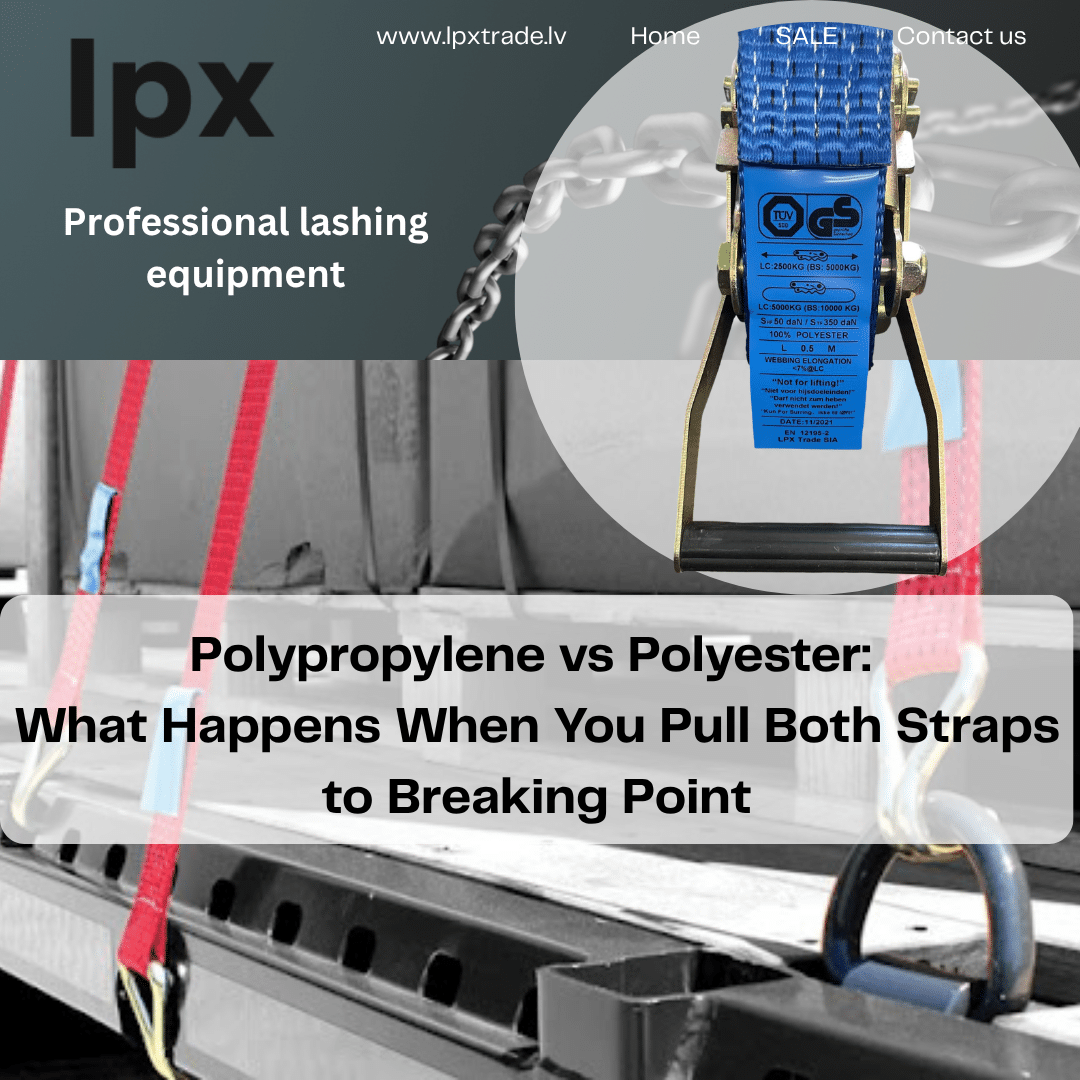
What is the difference between polypropylene and polyester straps?
The difference between polypropylene and polyester straps is elongation: polyester stretches only about 5% at working load and holds the cargo in place, whereas polypropylene stretches several times more and lets the load shift — so EN 12195-2 effectively rules PP out of cargo lashing. The two straps can look almost identical, so tell them apart by label colour: polyester = blue, polypropylene = brown, polyamide = green. For securing cargo on the road, only polyester (the blue label) is the right choice.
Picture two lashing straps side by side on a table. Same 50 mm width, same ratchet, both brand new, both marked with an LC value. The buyer reaches for the one that is 30% cheaper — perfectly reasonable. A month later, however, the load on that strap shifts on a motorway in Poland, the driver picks up a fine, and the company gets a claim for damaged goods.
The strap did not snap. Instead, it did something worse: it stretched. And that is the entire difference between polypropylene and polyester — two materials that look almost the same but behave very differently once they are out on the road. Below we break down what happens to each material under load, why the standard rules polypropylene out of lashing, and how to tell the two straps apart in two seconds. To then size the securing itself, see our 2-minute LC calculation.
Why does the material matter more than breaking strength?
When people compare straps, they look at one number: breaking force (BF). It feels logical — the higher the figure, the stronger the strap. For securing cargo, however, a different parameter matters far more, and almost nobody thinks about it: elongation under load.
The logic is simple. A lashing strap’s job is not to “hold the weight” — it is to keep the load from moving. If the strap stretches like a rubber band, then the first hard brake or sharp turn gives the load room to travel: it shifts a couple of centimetres, builds momentum, and slams into the next strap as a shock load. After that, it is a domino effect — exactly the kind of chain reaction we cost out in the cost of damaged cargo.
This is why the European standard EN 12195-2 caps the elongation of a lashing strap: it must not exceed 7% at working load (LC). Good polyester straps, meanwhile, typically come in around 5%. That figure is the line that separates a “lashing” material from a “packaging” one.
Polyester (PES) — blue label
Polyester is the industry standard for lashing, and for good reason. If you see a blue label on a strap, you are holding a polyester strap.
Strengths
- Low elongation — around 5% at LC. The strap barely stretches, so the load stays exactly where you secured it.
- High breaking strength for a given webbing width.
- Minimal creep — the strap does not “give back” its tension over the course of a trip.
- Good UV resistance — it does not break down in sunlight as quickly as other materials. Important for flatbeds and long routes.
- Resistant to most mineral acids.
Weaknesses
- Vulnerable to alkalis: an alkaline environment attacks the fibre. Keep it away from harsh chemicals and never clean it with soda-based solutions.
- More expensive than polypropylene — but you pay for precisely the properties lashing requires.
Polypropylene (PP) — brown label
Polypropylene is light, cheap and chemically resistant. The problem is not that it is a bad material; instead, the problem is that it often gets put on the wrong job. A brown label on a strap means polypropylene.
Strengths
- Very light — density around 0.90 g/cm³. Polypropylene literally floats on water (handy for a quick test, below).
- Resistant to both acids and alkalis — it beats polyester in aggressive chemical environments.
- Cheaper — the saving at purchase is noticeable.
Weaknesses
- High elongation — polypropylene stretches several times more than polyester. For lashing, that is a disqualifying flaw: the load gets room to move.
- Lower breaking strength for the same webbing width.
- Poor UV tolerance — in sunlight it degrades faster, losing strength invisibly.
- Lower melting point — it copes worse near hot surfaces and under friction.
The verdict on polypropylene: an excellent material for bundling, packaging and light fixing, where there is no need to hold a heavy load in place. For securing cargo under EN 12195-2, however — no.
Bonus: polyamide (PA) — green label
Occasionally you will meet a third material — polyamide (nylon), with a green label. It is strong, but it has two traits that make it rare in lashing: high elongation and a tendency to absorb moisture. A wet polyamide strap loses some of its strength and stretches noticeably under load. That is why polyester dominates road lashing.
Polypropylene vs polyester (and polyamide): the comparison table
| Property | Polyester (PES) | Polypropylene (PP) | Polyamide (PA) |
|---|---|---|---|
| Label colour | Blue | Brown | Green |
| Elongation under load | Low (~5%) | High | High |
| Breaking strength | High | Medium | High |
| UV resistance (sun) | Good | Weak | Medium |
| Acids / alkalis | Weak to alkalis | Resists both | Weak to acids |
| Moisture | Barely absorbs | Does not absorb | Absorbs, weakens |
| Suitable for lashing (EN 12195-2) | Yes | No | Rarely |
Elongation and density depend on the specific webbing; the values above are a guide for comparing materials.
The break test: what really happens under load
Polyester. A polyester strap holds its shape almost to the very end. The webbing stretches minimally, tension stays high, and the load underneath it stays put. When the load finally exceeds the limit, the strap fails sharply and predictably — at its rated breaking value. Up to that moment, therefore, it does exactly what it was bought to do: it holds.
Polypropylene. A polypropylene strap behaves differently. Long before it breaks, it starts to stretch visibly. On the load this looks like this: the strap appears taut, the ratchet is cranked all the way down, yet every jolt gives the cargo a few centimetres of travel. Those centimetres turn into momentum, momentum into shock load, and in the worst case the load works the lashing loose before the webbing ever tears.
The paradox is that polypropylene can look reliable right up to the moment of failure: it does not snap, it lets go. That is precisely why both the inspector and your safety depend not only on the BF figure on the label, but on the material behind that figure.
How to tell the materials apart in two seconds — no lab required
Two simple methods work in a real warehouse or garage:
1. The label colour
This is the fastest and most official sign. Under European marking, the label colour directly encodes the material:
- Blue label — polyester (PES). The one you want for lashing.
- Brown label — polypropylene (PP).
- Green label — polyamide (PA).
If the label is missing or unreadable, the strap cannot be used for lashing under EN 12195-2 at all, regardless of material. That is a separate violation in its own right, so replace it rather than guess.
2. The water test (when there is no label)
Polypropylene is lighter than water and will not sink — its density is around 0.90 g/cm³. Polyester is denser than water (around 1.38 g/cm³) and goes straight to the bottom. So drop an offcut of webbing into a bucket of water: floats — polypropylene; sinks — polyester or polyamide. Rough, but in the field it tells “packaging” material from “lashing” material instantly.
Which strap should you choose for the job?
Choose polyester if:
- You are securing cargo for road transport in the EU and must comply with EN 12195-2.
- You haul heavy or high-value loads where any shift is unacceptable.
- You work on open flatbeds and in direct sun (UV resistance matters).
- You want the strap to hold tension for the whole trip, not just the first few kilometres.
Polypropylene is acceptable if:
- You need light bundling, packaging or fixing that is not responsible for holding a heavy load.
- Resistance to alkaline chemicals is critical.
- Minimum weight and price matter, and there is no EN 12195-2 load requirement.
Choose straps that hold, not stretch. LPX Trade high-tenacity polyester lashing straps — blue label, ~5% elongation at LC, EN 12195-2 marked. Declaration of Conformity with every item.
FAQ: polypropylene vs polyester straps
Can a polypropylene strap never be used for lashing?
For securing cargo under EN 12195-2 — no, because of its high elongation. For light bundling and packaging — yes, that is its normal field of use. The question is not about “quality” but about matching the material to the job.
How do I identify the material if the label has worn off?
Quickly, with the water test: polypropylene floats, polyester sinks. But remember — a strap with an unreadable label cannot legally be used for lashing, so it should be replaced, not identified by eye.
Why is polyester more expensive if both are plastic?
You are not paying for “plastic” — you are paying for low elongation, high strength and UV resistance. For lashing, those properties are the product. A cheap strap that stretches actually costs more in transport, through fines and damage.
What matters more on the label — LC or the material?
Both. LC shows the working load; the material shows how the strap behaves under that load. A high LC on polypropylene does not cancel out its elongation. Therefore read the figure and the label colour together.
What colour is a polyester lashing strap label?
Blue. Under EN 12195-2 marking, a blue label means polyester (PES), a brown label means polypropylene (PP), and a green label means polyamide (PA). For road cargo lashing you want the blue label.
Author: LPX Trade Editorial Team — a supplier of certified lashing and rigging equipment for road freight across Europe. Content is based on the current standards and on hands-on work with EU carriers.
Last updated: 2 August 2026.
Sources: EN 12195-2 (webbing lashings — elongation ≤7% at LC, label-colour code); EN 12195-1:2010 (calculation of securing forces); VDI 2700 (securing of loads on road vehicles).