
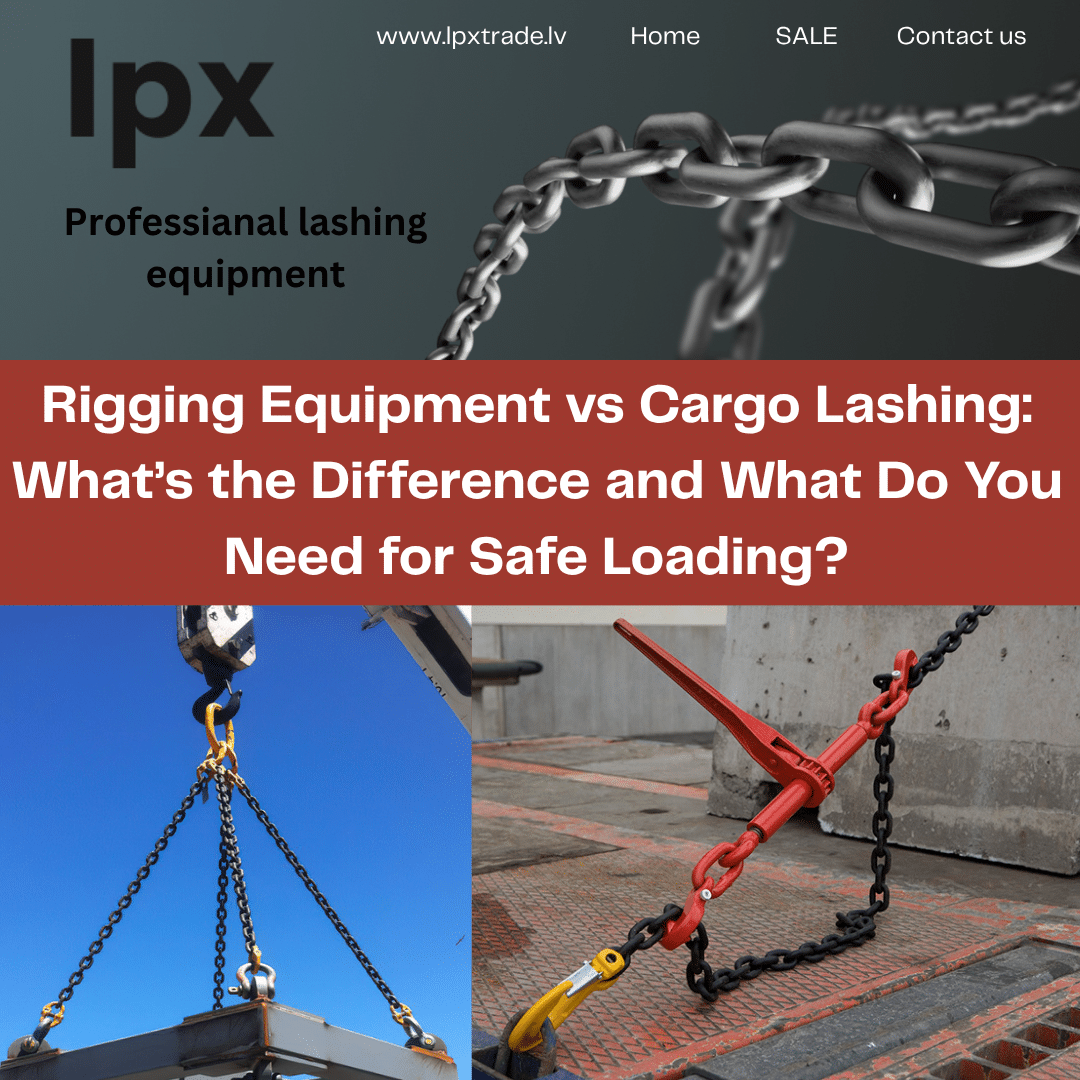
Rigging equipment vs cargo lashing: what’s the difference?
Rigging equipment vs cargo lashing is simple once you know the job: rigging lifts and moves the load during loading and unloading, while cargo lashing secures it on the vehicle for the whole journey. They use different standards (EN 1492 / EN 818 for rigging, EN 12195 for lashing), different ratings (WLL for lifting, LC for securing) and even different certification — lifting slings are CE-marked, lashing straps are not. Confusing the two is dangerous: the wrong equipment leads to cargo damage, roadside fines and workplace accidents. Here is the difference and what you need for each.
What is rigging equipment?
Rigging equipment lifts, moves and positions loads during loading and unloading. It does its work briefly, under a vertical load, and is removed once the load is placed. Common rigging equipment includes:
- Textile slings (EN 1492-1) — for general and palletised cargo
- Chain slings (EN 818-2) — for metal, hot or abrasive loads
- Wire rope slings (EN 13414-1) — for very heavy or sharp-edged loads
- Hooks, shackles and carabiners — connecting components
- Lifting clamps for plates, pipes and pallets
- Eye bolts and welded lifting rings
- Blocks, pulleys and turnbuckles
Key parameter: WLL (Working Load Limit) — the maximum working load on a sling in the vertical position. Standards: EN 1492-1 (textile), EN 818 (chain). Browse rated round slings and flat webbing slings.
What is cargo lashing equipment?
Cargo lashing equipment secures a load on a vehicle during transport. Unlike rigging, it stays on the load for the whole journey and comes off only on arrival, and it works against horizontal, dynamic forces. Common cargo lashing equipment includes:
- Ratchet lashing straps (EN 12195-2) — universal securing
- Chain lashings with hooks (EN 12195-3) — for heavy machinery
- Wire rope lashings and tensioners — for long loads
- Anti-slip mats and pads — cut the required LC by 20–60%
- Corner protectors — protect strap and load at sharp edges
- Cargo nets and tarpaulins
Key parameter: LC (Lashing Capacity) — the calculated restraint force. Standards: EN 12195-1 (calculation method), EN 12195-2 (straps). To size it, use our 2-minute LC calculation, and to choose a strap, the selection guide.
What is the difference between rigging and cargo lashing equipment?
The core difference is the job: rigging lifts (a brief, vertical load during loading and unloading), whereas lashing restrains (a continuous, dynamic load during transport). Therefore a lifting sling must never be used as a lashing strap, and a lashing chain must never be used to lift — different geometry, different marking, different certification.
| Parameter | Rigging equipment | Cargo lashing equipment |
|---|---|---|
| When used | Loading / unloading | During transport |
| Removed | After placing the load | On arrival |
| Main standard | EN 1492, EN 818 | EN 12195 |
| Key parameter | WLL (Working Load Limit) | LC (Lashing Capacity) |
| Certification | CE-marked (Machinery Directive 2006/42/EC) | Not CE-marked; EN 12195-2 label + Declaration of Conformity |
| Example | Textile sling, WLL 2 t | Ratchet strap, LC 2500 daN |
That last row matters and is widely misunderstood — see “Do lashing straps need CE marking?” in the FAQ below. The same lift-vs-secure split explains why a lashing chain (EN 12195-3) is not a lifting chain (EN 818).
How do you calculate WLL based on the lifting angle?
For rigging, the WLL falls as the angle between the sling legs widens, because each leg then carries more than its share. Under EN 1492-1 (Annex B), the guide factors are:
| Angle between sling legs | WLL factor | Practical note |
|---|---|---|
| 0° (vertical) | 100% | Full rated WLL |
| Up to 45° | 100% | Safe working range |
| 45° – 60° | 82% | Always select with margin |
| 60° – 90° | 71% | Use a heavier sling grade |
| Over 90° | ≤ 50% | Avoid if possible |
Practical rule: always pick a sling with a WLL comfortably above the calculated load, allowing for angle and dynamic forces. This is the lifting-side cousin of the angle correction we apply to lashing in the LC and lashing-angles guide.
What is the checklist for safe loading and cargo securing?
- Check WLL and LC. The load on the equipment must not exceed its WLL (lifting) or LC (securing), allowing for angle and safety factor.
- Inspect before every use. Cuts, abrasion, corrosion or cracked hooks mean immediate withdrawal from service — the same logic as for eye bolts and turnbuckles.
- Use corner protectors. Sharp edges damage textile slings and straps even on light contact.
- Keep the right documentation. The regimes differ: lifting slings are CE-marked as lifting accessories under the Machinery Directive 2006/42/EC and come with a Declaration of Conformity; cargo lashing straps are not CE-marked — they carry an EN 12195-2 label and a manufacturer’s Declaration of Conformity. Keep the relevant document with the equipment.
- Match the method to the cargo. Flat loads: top-over (tie-down). Cylindrical: direct or loop lashing plus blocking. Fragile: padding and reduced tension. See the 5 cargo securing methods, and attach only to rated lashing points (EN 12640).
Rigging to lift, lashing to secure — both certified. LPX Trade supplies rigging slings CE-marked under the Machinery Directive, and EN 12195 lashing straps and chains with a Declaration of Conformity to EN 12195-2. Delivery across Europe; documentation with every order.
FAQ: rigging equipment vs cargo lashing
What is the difference between rigging and lashing?
Rigging lifts and positions the load during loading and unloading; lashing secures it on the vehicle during transport. Rigging works under a brief vertical load (rated by WLL, to EN 1492/EN 818); lashing works against continuous dynamic forces (rated by LC, to EN 12195). They are removed at different points — rigging after placing the load, lashing on arrival.
Can I use a lifting sling as a lashing strap?
No. A lifting sling and a lashing strap have different load geometry, marking and certification. A sling is designed for a vertical lift and is CE-marked as a lifting accessory; a lashing strap is designed for horizontal restraint under EN 12195-2. Using one for the other is unsafe and non-compliant at inspection.
What is the difference between WLL and LC?
WLL (Working Load Limit) is the maximum load a sling may lift, usually in the vertical position. LC (Lashing Capacity) is the calculated restraint force a lashing provides in transport. WLL belongs to rigging under EN 1492/EN 818; LC belongs to lashing under EN 12195.
Do lashing straps need CE marking?
No. Cargo lashing straps are not CE-marked; they carry an EN 12195-2 label (LC, STF, material) and a manufacturer’s Declaration of Conformity. Lifting slings are different — they are CE-marked as lifting accessories under the Machinery Directive 2006/42/EC. So “CE” applies to the rigging side, not to lashing straps.
Can I use a lashing chain for lifting?
No. A lashing chain (EN 12195-3, marked LC) is built to restrain cargo in transport, not to hoist it. A lifting chain (EN 818, marked WLL) is a different product with a different safety factor. Never lift a load with a lashing chain.
Author: LPX Trade Editorial Team — a supplier of certified rigging and EN 12195 lashing equipment across Europe. Based on the current standards and on practical work with EU carriers.
Last updated: 2 August 2026.
Sources: EN 1492-1 (textile slings, WLL and angle factors); EN 818-2 (chain slings); EN 13414-1 (wire rope slings); EN 12195-1:2010 and EN 12195-2/-3 (cargo securing); Machinery Directive 2006/42/EC (CE marking of lifting accessories).