
How does quality cargo securing reduce logistics losses?
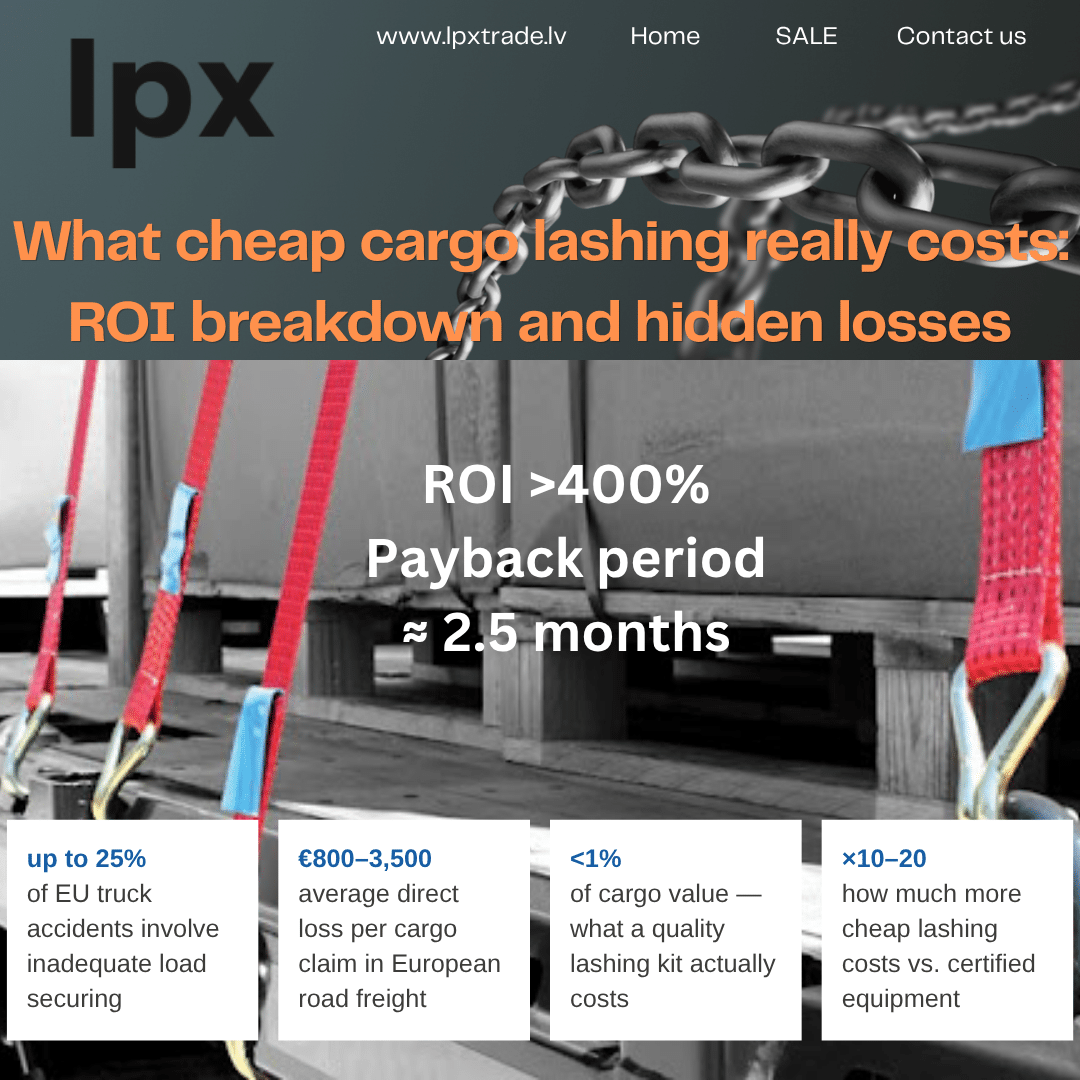
Quality cargo securing reduces logistics losses by preventing the claims, re-deliveries, downtime, fines and premium hikes that a single lashing failure triggers — costs that dwarf the price of the equipment itself. Certified lashing gear is under 1% of cargo value, yet in a model 12-truck fleet it returns roughly 490% ROI with payback in about 2.5 months, because it cuts damage claims by around 75%. In short, lashing is not a cost line — it is an investment with a measurable yield.
Every logistics manager knows the feeling: the shipment arrives, but the customer files a claim — crushed pallets, damaged packaging, shifted goods. A damage report, negotiations, a re-delivery. The culprit is almost always the same: lashing materials chosen on the basis of “cheapest available”. This is not an exception — it is a systemic problem in European freight. According to the European Commission’s road safety data, up to 25% of truck accidents in the EU involve inadequate load securing, yet a quality lashing kit typically costs less than 0.5–1% of the goods it protects. The problem is not the price of straps; it is that companies never calculate the full cycle of losses a failure sets off. For the single-incident view under CMR, see the cost of damaged cargo.
| Figure | What it means |
|---|---|
| up to 25% | of EU truck accidents involve inadequate load securing (EC road safety) |
| €800–3,500 | average direct loss per cargo claim in European road freight (CMR / industry) |
| < 1% | of cargo value — what a quality lashing kit actually costs |
| ≈ 490% | modelled ROI of switching to certified equipment (see calculation below) |
Where do logistics losses actually hide?
Most carriers track only the direct loss from cargo damage. In reality, though, the hidden list is an order of magnitude longer — and it is this list that decides the true economics of any lashing decision.
| Cost category | What it includes | Who absorbs it |
|---|---|---|
| Claims and compensation | Value of damaged goods, client reimbursement, admin of the claim | Carrier / insurer |
| Re-delivery | A repeat run, repackaging, extra warehouse handling | Carrier |
| Vehicle downtime | Waiting on the incident, paperwork, a delayed next run | Carrier |
| Contract & regulatory fines | Missed-window penalties; roadside fines under Directive 2014/47/EU | Driver + carrier |
| Insurance premium | Each event raises the base premium at renewal (EU freight +8.7% over 3 years) | Carrier |
| Reputational damage | Lost recurring clients, lower platform ratings, withdrawn referrals | Carrier — often the biggest loss |
ROI case: a 12-truck Baltic-to-Western-Europe fleet
Here is a model calculation for a mid-sized carrier running 12 vehicles from Latvia, Lithuania and Estonia to Germany, the Netherlands and Poland, carrying appliances, spare parts and industrial equipment. The parameters draw on IRU benchmarks and CMR insurance data.
| Cost item | Amount (€/year) |
|---|---|
| Budget straps (12 vehicles × 20) | 1,440 |
| Client claims (8 incidents × €1,800) | 14,400 |
| Re-deliveries (5 × €950) | 4,750 |
| Downtime + admin | 3,200 |
| Insurance premium increase (+12%) | 2,880 |
| Total real annual cost | 26,670 |
| Cost item | Amount (€/year) |
|---|---|
| Certified straps + edge protectors (12 vehicles) | 3,960 |
| Client claims (−75% → 2 × €1,800) | 3,600 |
| Re-deliveries (1 incident) | 950 |
| Admin | 800 |
| Insurance premium (normalised) | 2,400 |
| Total real annual cost | 11,710 |
Extra spend on lashing = €3,960 − €1,440 = €2,520
ROI = (14,960 − 2,520) / 2,520 × 100% = ≈ 493% · payback ≈ 2.5 months
So every extra euro invested in quality securing returns about €4.93 in net savings a year — and that is conservative, because it excludes lost clients and long-term reputational risk. To size the kit rather than guess, use our 2-minute LC calculation.
“The strap is not what holds the cargo. It is what stops it from killing you during emergency braking. The physics are simple: 10 tonnes at 0.8 g deceleration generates 8 tonnes of horizontal force — a cheap strap is not rated for that.”
What should you look for in cargo securing equipment?
Lashing straps. Conformity to EN 12195-2 (the benchmark EU inspectors judge straps against); LC of at least 2,500 daN for heavy cargo; STF of at least 400 daN to hold the load down; polyester webbing for moisture, UV and temperature resistance; and a double-lock ratchet against self-loosening. Why polyester rather than the cheaper option? See polypropylene vs polyester.
Edge protectors and anti-slip mats. Edge protectors cut strap stress at contact points by 30–40%; anti-slip mats with a friction coefficient of about 0.6 (VDI 2700) reduce the lashing points needed by 1.5–2×. Both belong in the plan, not the “nice to have” pile — browse anti-slip mats and blocking.
Cargo nets and webbing. For curtainsiders, polyester nets with a mesh around 40×40 mm; the net’s rating must match the total secured weight; and the rail anchorage points need a look before every run, since damaged rails compromise the whole system.
A systemic approach: checklists and per-cargo plans
Two habits capture most of the gain. First, a pre-departure checklist — visual strap inspection, ratchet check, and a tension re-check at 50–100 km once the load has settled — with every strap replacement logged, which quietly reveals your problem routes and cargo types. Second, per-cargo lashing plans: a blanket “20 straps per truck” wastes material and misses risk, whereas route cards with a prescribed scheme per cargo type cut both waste and incidents. Match each load to the right one of the 5 cargo securing methods.
The bottom line
Quality cargo securing is not a cost line; it is an insurance instrument with a measurable yield and a brand-protection tool — in an era when one viral claim can cost more than a year of trading. And because non-certified gear can also undermine a claim, it pays to read how certification protects your cargo insurance.
Calculate your ROI from quality securing. Tell us your cargo types and routes, and an LPX Trade specialist will put together a free lashing-equipment selection. All EN 12195, LC/STF-marked, Declaration of Conformity on request.
FAQ: quality cargo securing and ROI
What is the ROI of certified lashing equipment?
In a model 12-truck fleet, switching from budget to certified equipment saves about €14,960 a year for €2,520 of extra spend — roughly 493% ROI, with payback in about 2.5 months. The gain comes mainly from cutting damage claims by around 75%. Actual figures depend on cargo, routes and claim history.
How much do logistics losses from poor securing add up to?
Beyond the damaged goods, a lashing failure triggers re-delivery, downtime, contract and roadside fines, higher premiums and reputational loss. The average direct loss per cargo claim in European road freight runs about €800–3,500, and the hidden costs often exceed the direct one.
How much should I spend on lashing versus cargo value?
A quality lashing kit typically costs less than 0.5–1% of the value of the goods it protects. Against that, a single denied or reduced claim can run into tens of thousands of euros, which is why the return on certified equipment is so high.
Is EN 12195 equipment mandatory?
EN 12195 is a voluntary European standard, but inspectors and courts across the EU treat it as the benchmark for adequate securing under Directive 2014/47/EU. In practice, certified EN 12195 equipment is what lets you demonstrate compliance at a roadside check or an insurance claim.
Author: LPX Trade Editorial Team — a supplier of certified EN 12195 cargo securing equipment to carriers across the Baltic region and the EU. Based on current standards and on IRU / CMR industry benchmarks.
Last updated: 2 August 2026.
Sources: European Commission — Road Safety (up to 25% of accidents linked to inadequate securing); IRU European Road Freight Rate Benchmark Q4 2023 (insurance +8.7% over 3 years); European Best Practice Guidelines on Cargo Securing (EC DG MOVE) and VDI 2700; EN 12195-1/-2.
The ROI figures above are an illustrative model with stated assumptions, not a guarantee; plug in your own claim history and rates.