
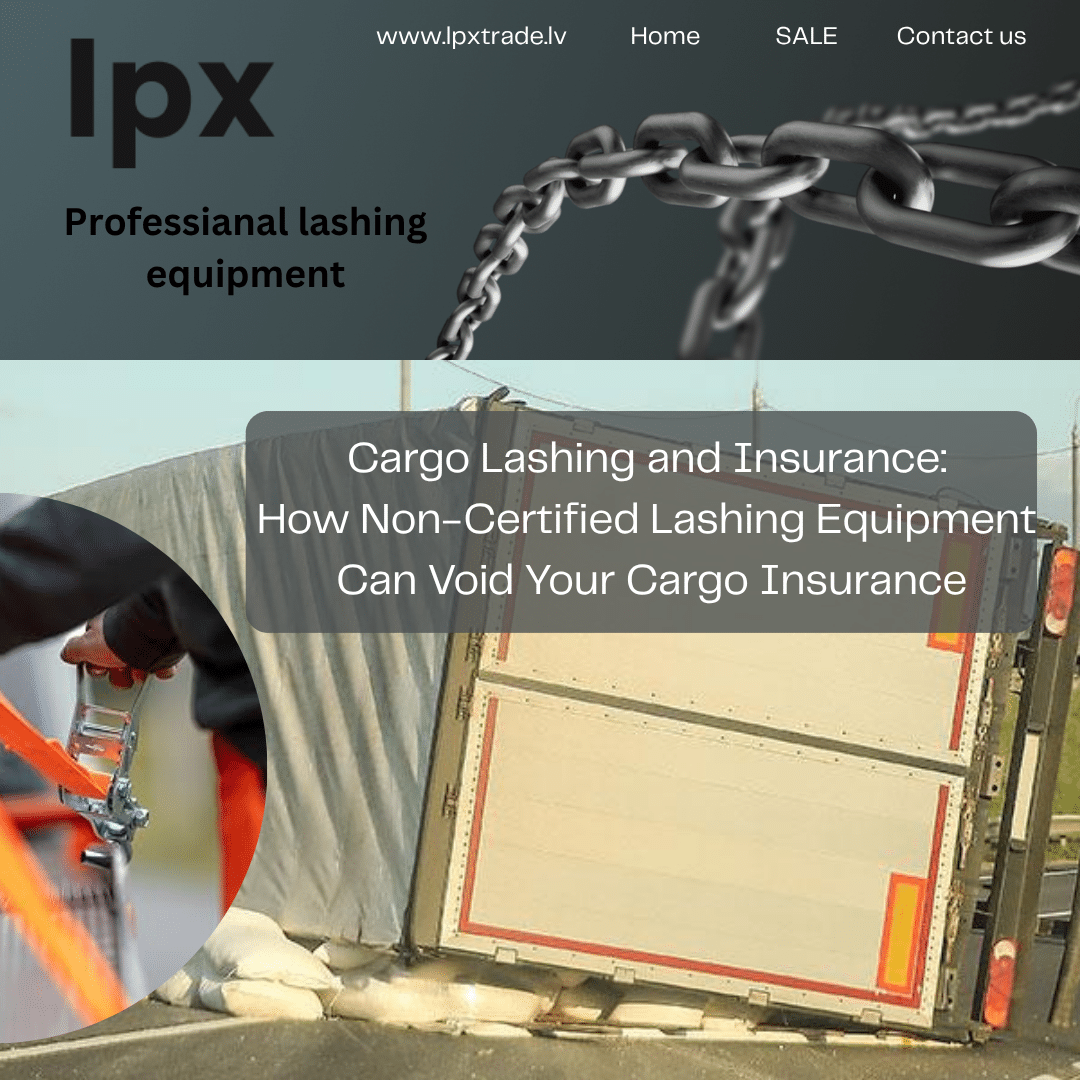
Can non-certified lashing equipment void your cargo insurance?
Yes — non-certified lashing equipment can give an insurer grounds to reduce or reject a cargo claim, because most European cargo and CMR policies require you to secure the load to the applicable standard, which across the EU means EN 12195. A compliant strap carries its EN 12195-2 label (blue for polyester) showing LC, STF and BF; without it, you cannot prove the equipment met the standard, and the carrier — not the insurer — carries the burden of proof. So the equipment you buy is not only a safety choice; it can also decide whether a claim gets paid.
Every logistics manager knows the sinking feeling of a damage claim. Fewer realise, however, that the claim may not just be expensive — under the wrong circumstances it may be uninsured. So below we set out the legal framework, explain what “certified lashing equipment” actually means, and show how missing certification can affect a cargo claim.
What does EU law actually require for cargo lashing?
It helps to be precise here, because people often overstate the point. EU law — chiefly Directive 2014/47/EU on roadside technical inspections — requires carriers to secure cargo adequately. It does not name a single brand or product. In practice, however, inspectors and courts across the EU judge that adequacy against EN 12195, so “adequately secured” effectively means “secured in line with EN 12195”.
EN 12195: the European load-securing standard
EN 12195 is a voluntary European standard, yet the industry treats it as the de facto benchmark for load securing. It has four parts: EN 12195-1 (calculation of securing forces), EN 12195-2 (webbing lashing straps), EN 12195-3 (lashing chains) and EN 12195-4 (steel wire ropes). Certified equipment complies with the relevant part; cheap unbranded straps typically do not — so first size the lashing correctly.
Directive 2014/47/EU: roadside enforcement
Directive 2014/47/EU harmonises roadside inspection across the EU. Non-compliant equipment can therefore trigger an immediate fine for driver and carrier, detention of the vehicle until they fix the issue, and a formal inspection report — which an insurer can later cite in a claim dispute. For the detail, see our guide to cargo lashing fines.
The CMR Convention: the carrier’s liability
Under the CMR Convention, the carrier answers for the cargo from loading to delivery, so improper securing puts that liability squarely on the carrier. CMR insurance normally covers it; however, most policies require compliance with the applicable securing standards, and non-certified equipment can breach that condition. We explain the liability cap itself in the cost of damaged cargo.
How can non-certified equipment affect a claim?
Most European cargo policies, including CMR cover, contain a compliance clause: you must secure the cargo in line with applicable regulations and standards. So when you file a claim, the insurer investigates the cause. If they find that you used non-certified straps, they may apply that clause. Crucially, the carrier carries the burden of proof: you must show that you used certified equipment and applied it correctly. Without an EN 12195-2 label, you simply cannot demonstrate that.
What must a compliant lashing strap show?
Under EN 12195-2, every compliant strap carries a visible, intact label on its detachable parts. A polyester strap carries a blue label; a polypropylene strap carries a brown one and polyamide a green one — so the colour signals the material, as we explain in polypropylene vs polyester. The label must show:
- LC — Lashing Capacity in daN, the rated force in direct lashing
- STF — Standard Tension Force, the pre-tension from a 50 daN hand force
- BF — Breaking Force, at which the strap fails (as a rule, at least 2× the LC)
- Manufacturer and standard reference (and a test mark such as TÜV/GS, where available)
Without a legible label, you cannot show that a strap meets EN 12195-2 — which is exactly why an inspector, or an insurer, treats it as equipment of unknown capacity.
What does non-certified equipment really cost?
Consider a carrier moving industrial equipment worth €40,000 on budget, unlabelled straps. The load shifts under braking and damages the goods. The carrier files a CMR claim; the assessor finds no label and cannot verify the LC, so the insurer applies the compliance clause. In a worst case the insurer reduces or denies the claim, and the carrier absorbs much of the €40,000 — plus re-delivery, penalties and legal costs. Meanwhile, the saving on the cheap straps was perhaps €80.
Beyond insurance, non-certified gear also creates regulatory exposure (on-the-spot fines under 2014/47/EU), potential liability after an accident from cargo shift, and higher premiums at renewal. By contrast, certified lashing equipment usually costs well under 1% of the cargo value it protects.
| Aspect | Certified (EN 12195-2) | Non-certified |
|---|---|---|
| Label | Intact, legible (LC, STF, BF, material) | Missing, generic or illegible |
| Rated values | Verifiable LC/STF | Unknown / unverifiable |
| Roadside inspection | Passes | Fine + possible detention |
| Insurance claim | Compliance demonstrable | Compliance clause may apply |
| Documentation | Declaration of Conformity available | Usually none |
How do you keep your lashing equipment compliant?
Run a short check before every load:
- ☐ Every strap has an intact, legible EN 12195-2 label
- ☐ The LC is sufficient for the cargo weight and lashing angle
- ☐ The STF suits the tie-down application
- ☐ Ratchets and hooks show no cracks, deformation or corrosion
- ☐ Webbing has no cuts, abrasions or UV damage
- ☐ Damaged straps go out of service and get destroyed, never repaired
- ☐ The number of straps meets the EN 12195-1 calculation for the load
As good practice — and a requirement under some national health-and-safety rules — have a competent person examine the equipment at least once a year, and keep the records. So turn the pre-trip part into a routine with our driver lashing checklist, and apply the right securing method. Finally, when you source equipment, confirm that the products carry EN 12195 marking, that the labels are legible, and that the supplier can provide a Declaration of Conformity.
Certified equipment is part of your cover. LPX Trade supplies EN 12195-2 ratchet straps, EN 12195-3 chains, cargo nets, slings and accessories — all with legible LC/STF marking and a Declaration of Conformity available on request.
FAQ: cargo lashing and insurance
Can non-certified lashing equipment void cargo insurance?
It can. Most European cargo and CMR policies require you to secure the load to the applicable standard (EN 12195 in the EU). So if a claim investigation finds non-certified straps with no verifiable LC, the insurer may apply the policy’s compliance clause and reduce or reject the claim. The exact outcome depends on the policy wording.
What is the blue label on lashing straps?
The blue label is the EN 12195-2 marking on a polyester lashing strap; a polypropylene strap carries a brown label and polyamide a green one, so the colour signals the material. The label shows LC, STF and BF plus the manufacturer and standard. Without a legible label, you cannot show that a strap meets EN 12195-2.
Does EU law require EN 12195 equipment?
EU law (Directive 2014/47/EU) requires carriers to secure cargo adequately rather than naming EN 12195 directly. However, inspectors and courts across the EU judge adequacy against EN 12195, so in practice compliant equipment is what meets the requirement.
How often should you inspect lashing straps?
Inspect every strap visually before each use, and — as good practice and under some national rules — have a competent person examine the equipment at least once a year. Straps that fail go out of service and get destroyed, so nobody can reuse them; you do not repair them.
Author: LPX Trade Editorial Team — a supplier of EN 12195 cargo securing equipment across Europe. Based on the current standards and on practical work with EU carriers.
Last updated: 2 August 2026.
Sources: Directive 2014/47/EU (roadside technical inspection); EN safe load securing guidelines (IRU); CMR Convention FAQ; EN 12195-1/-2/-3/-4 (load securing).
This article is general information, not legal or insurance advice. Policy wordings and national rules differ — check your own CMR/cargo policy and local regulations for the exact requirements.