
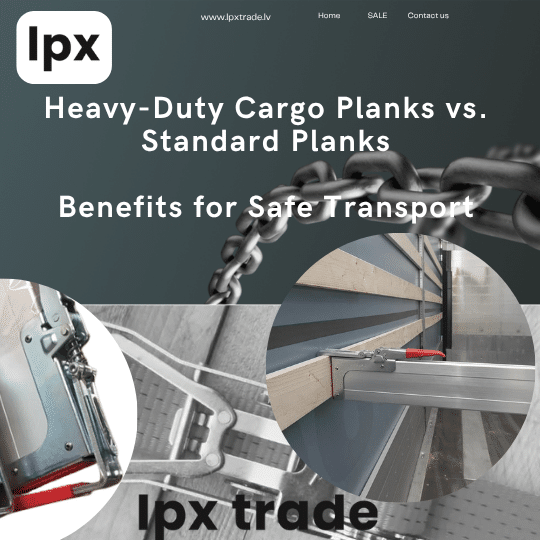
Heavy-Duty Cargo Planks vs. Standard Planks | Benefits for Safe Transport
In modern logistics, every detail matters — especially when you’re transporting cargo across long distances or through changing weather conditions. One of those “small but crucial” details is the plank you choose for securing, separating, or supporting your cargo. Many transport companies still rely on standard planks because they are cheaper and widely available. But with heavy loads, long-haul routes, or demanding cargo, standard planks simply aren’t enough. This is where heavy-duty cargo planks come in. Built for strength, impact resistance, and long-term reliability, they help transport companies prevent damage, reduce claims, and improve operational safety. In this article, we’ll break down the key differences between heavy-duty cargo planks and standard planks — and why upgrading may save you more than it costs.
1. What Are Standard Cargo Planks?
Standard cargo planks are the most common type used in general transport applications. They are typically made from basic hardwood or regular composite materials. Their purpose is simple:
Separate layers of cargo
Distribute weight
Create a stable base
Prevent sliding inside trailers
Standard planks work well when cargo is relatively light, evenly distributed, or not sensitive to pressure.
However, in real transport operations — especially in Latvia, Lithuania, and wider EU logistics — cargo conditions are rarely “standard.” Loads can shift, trailers face vibrations, winter cold weakens wood, and forklifts add impact stress. This is where standard planks reach their limit.
2. What Makes Heavy-Duty Cargo Planks Different?
Heavy-duty cargo planks are engineered specifically for challenging environments. They are usually made from reinforced materials such as:
High-density hardwood
Strengthened composite
Aluminum-reinforced structures
Their design focuses on maximum load capacity, durability, and resistance to extreme handling. A few characteristics that set heavy-duty cargo planks apart:
a) Higher Load Capacity
Heavy-duty planks are designed to withstand significantly more weight.
Where standard planks may start bending or deforming at high pressure, heavy-duty planks maintain structural integrity.
This reduces:
✔ Breakage
✔ Dangerous load shifts
✔ Trailer floor damage
✔ Pressure points on cargo
For companies that frequently transport machinery, construction materials, pallets with liquids, or uneven loads — this is a major advantage.
b) Better Impact Resistance
Forklift impact is one of the main causes of plank damage. Standard planks often crack when hit, especially during winter months. Heavy-duty cargo planks absorb impact far better because of their construction density and engineered strength.
This means fewer replacements and a longer lifespan — lowering long-term operational costs.
c) Improved Weather Performance
Latvia, Lithuania, and the wider Baltic region experience extreme seasonal changes. Moisture, snow, and freezing temperatures can weaken regular planks. Heavy-duty planks are far more resistant to:
Moisture absorption
Warping
Cracking
Deformation due to cold
Their stability in winter is one of the main reasons Baltic transport companies are switching to heavy-duty options.
d) Longer Service Life
While standard planks often need replacing after a few months in active operations, heavy-duty cargo planks can last several years.
Even though the initial investment is higher, the cost per year is usually significantly lower.
3. Benefits of Heavy-Duty Cargo Planks for Transport Companies
3.1. Reduced Cargo Damage
Heavier, stronger planks create a more stable load environment. This reduces damage to:
Furniture
Electronics
Food & beverages
Construction materials
Industrial cargo
Fewer complaints mean less stress — and higher customer satisfaction.
3.2. Better Weight Distribution
Heavy-duty planks distribute weight more efficiently across the trailer floor. This protects both the cargo and the trailer itself.
Transport companies often underestimate how much damage uneven loads can cause to flooring, walls, and lashing systems.
3.3. Enhanced Safety for Drivers and Loaders
A broken plank inside a trailer is a serious safety risk. Heavy-duty planks significantly reduce the chances of sudden breakage and load collapse.
Better stability means safer working conditions for forklift operators, warehouse workers, and drivers.
3.4. Lower Long-Term Costs
Even though heavy-duty planks cost more upfront, the total cost over time is usually lower because:
The replacement cycle is longer
They don’t break easily
They reduce cargo claims
They prevent trailer floor damage
For companies with frequent or heavy shipments, this can result in substantial savings.
4. When Should You Choose Heavy-Duty Cargo Planks?
If your transport operations involve any of the following, heavy-duty cargo planks are the ideal choice:
Heavy palletized cargo (tiles, bricks, liquids, metal products)
Multilevel loading with significant pressure on each layer
Machinery or industrial equipment
Long-distance routes where vibrations are constant
High forklift traffic during loading/unloading
Winter operations in the Baltics and Scandinavia
Sensitive or valuable cargo where damage must be minimized
If your fleet serves strict customers such as automotive, electronics, pharmaceuticals, or food industries, investing in heavy-duty cargo planks is almost always necessary.
5. When Standard Planks Are Still Enough
Standard planks are suitable for:
Light goods
Evenly distributed pallet loads
Short-distance routes
Occasional use
For small-scale transport companies that move light cargo, standard planks can be a cost-effective solution. However, once weight, frequency, or risk increases — upgrading is strongly recommended.
6. Conclusion
The main difference between heavy-duty cargo planks and standard planks comes down to strength, durability, and safety. Heavy-duty cargo planks are built to handle demanding loads, cold temperatures, and constant forklift activity — making them a smarter long-term investment for professional transport companies.
For Latvian and Lithuanian logistics operators, where road conditions and winter weather can be challenging, heavy-duty cargo planks are not just “better”—they are often essential for safe, efficient, and damage-free transport.