
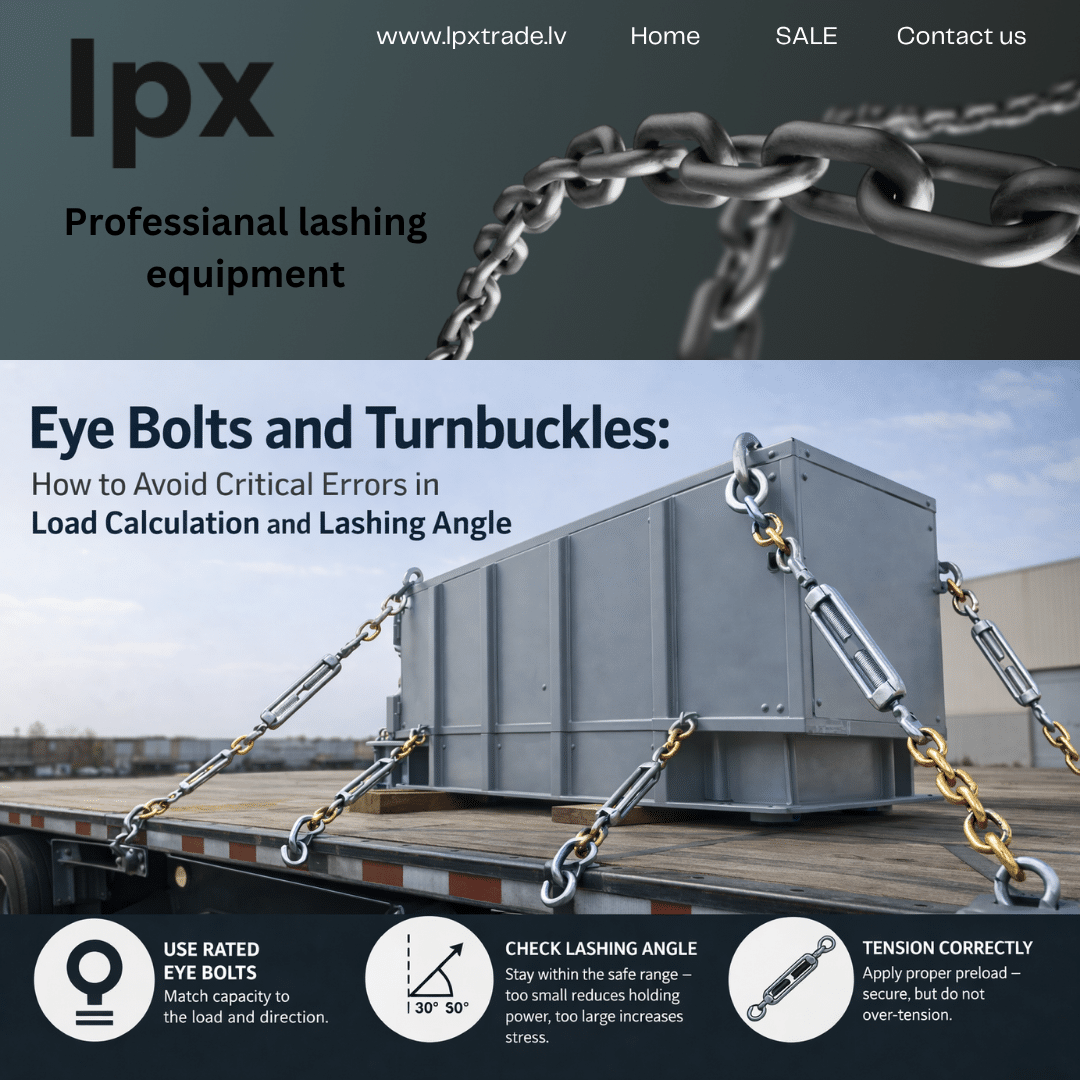
Eye Bolts and Turnbuckles: How to Avoid Critical Errors in Load Calculation and Lashing Angle
A Specialist Guide for Freight Transport Professionals
Introduction: The Cost of Getting It Wrong
Every year across Europe, thousands of road accidents are caused by cargo shifting or falling from vehicles. According to the European Cargo Securing Federation, incorrect lashing is responsible for one in every four serious accidents involving heavy goods vehicles. Eye bolts and turnbuckles are not just “bits of metal.” They are load-bearing components of the lashing system — and selecting and using them correctly is a matter of driver safety, road safety, and cargo integrity.
In this article, we break down the most common mistakes made when using eye bolts and turnbuckles in road transport: on flatbed trailers, platform vehicles, and shipping containers. You will get specific technical benchmarks, formulas, and practical recommendations — no filler, no generalities.
Part 1. Eye Bolts: More Than Just a Ring with a Thread
What Is an Eye Bolt and Where Is It Used?
An eye bolt is a fastener with a looped head and a threaded shank. It serves as a load attachment point for lifting, lashing, towing, and mooring operations. In transport logistics, eye bolts are used:
- as anchor points on trailer flatbeds for chains and lashing straps;
- as lashing rings inside shipping containers;
- as attachment points for pulleys, blocks, and tackles;
- for securing cargo on ferries and ro-ro vessels.
Types of Eye Bolts: Know the Difference
Standard eye bolt — designed exclusively for axial loading (along the bolt axis). Any angular deviation of the load dramatically reduces the Working Load Limit (WLL).
Collar eye bolt (swivel eye bolt) — features a rotating ring with a load-bearing collar, allowing angular loads of up to 90° without significant WLL reduction. This is the recommended type for transport applications where load direction is variable.
Hoist ring (side-loading eye bolt) — a specialised variant for dynamic loads and lifting. The ring rotates 360° in the horizontal plane and swings 180° in the vertical plane.
Material and Grade: Read the Markings
Eye bolts are marked according to property class (steel grade):
| Stiprības klase | Tensile / Yield Strength | Izmantošana |
|---|---|---|
| 4.6 | 400 / 240 MPa | Light loads, temporary fixings |
| 8.8 | 800 / 640 MPa | Standard transport use |
| 10.9 | 1000 / 900 MPa | Heavy loads, vibration environments |
| 12.9 | 1200 / 1080 MPa | Extreme loads |
Grade 8.8 is the minimum recommended for transport applications. Stainless steel A4-70 offers corrosion resistance but has a lower yield strength than alloy steel of the same diameter — factor this into your calculations.
Part 2. Critical Mistake #1 — Wrong Load Angle on the Eye Bolt
Why the Angle Matters So Much
This is the most common and most dangerous mistake. A standard eye bolt is rated for load applied strictly along its axis (0°). Any deviation from that axis causes a rapid drop in WLL.
WLL reduction table for a standard eye bolt by load angle:
| Load angle to bolt axis | WLL reduction factor | Remaining WLL (%) |
|---|---|---|
| 0° (axial load) | 1.0 | 100% |
| 15° | 0.65 | 65% |
| 30° | 0.50 | 50% |
| 45° | 0.35 | 35% |
| 60° | 0.25 | 25% |
| 90° (lateral load) | Not permitted | 0% |
Piemērs: An M16 eye bolt, grade 8.8, WLL = 2,000 kg at 0°. Under a 45° angular load, its actual permissible load drops to just 700 kg — and the bolt will look completely intact the entire time. These “invisible” overloads are exactly what causes sudden, unexpected failure.
Practical Solution
If an angled load is unavoidable, use a collar eye bolt. When properly torqued, it maintains up to 100% WLL under angular loading. When installing a collar eye bolt:
- Ensure the collar is fully seated and flush against the bearing surface.
- Torque the bolt to the manufacturer’s specified value.
- Verify that the plane of the ring aligns with the direction of the load.
Part 3. Critical Mistake #2 — Incorrect Eye Bolt Installation
Thread Engagement Depth and Bearing Surface
An eye bolt only achieves its rated WLL when the threaded shank is fully engaged in the supporting structure. Minimum thread engagement depth:
- Steel: 1.0 × thread diameter (minimum), 1.5 × d recommended
- Aluminium: 2.0 × thread diameter (minimum), 3.0 × d recommended
- Cast iron: 1.5 × thread diameter (minimum)
Piemērs: An M20 eye bolt installed in a steel trailer frame — minimum engagement 20 mm, recommended 30 mm. Where material thickness allows, use a nut and washer on the reverse side: this increases joint load capacity by 30–40%.
The Collar Gap — Critical Detail
There must be zero gap between the eye bolt collar and the bearing surface. Even a 0.5 mm gap creates a bending moment on the threaded shank, which under dynamic loads (road vibration, braking) leads to fatigue failure of the metal.
Practical check: after tightening, try rocking the ring by hand — there should be no play at the collar-to-surface joint whatsoever.
Corrosion Protection and Regular Inspection
Eye bolts on trailers and containers operate in aggressive environments: road de-icing chemicals, marine salt, temperature cycling. Required measures:
- Apply thread-locking compound on installation (Loctite 243 or equivalent) — it prevents self-loosening and thread corrosion.
- Conduct a visual inspection before every trip: cracks, ring deformation, rust at the thread zone.
- Replace the eye bolt immediately if you find: ring deformation exceeding 5% of nominal size, visible cracks, or corrosion pitting deeper than 0.5 mm.
Part 4. Cargo Turnbuckle: How It Works and Types
What Is a Turnbuckle and How Does It Work?
A turnbuckle (also called a rigging screw) is a threaded tensioning device consisting of a body (sleeve) with two end fittings threaded in opposite directions. Rotating the sleeve simultaneously draws both ends in or out, adjusting the overall length of the device and applying tension to the lashing system.
In freight transport, turnbuckles are used:
- to tension chains when securing cargo on trailers;
- in container lashing systems for sea and rail transport;
- to align and fix oversized loads;
- in diagonal lashing arrangements on flatbed platforms.
End Fitting Types
Hook–hook: fast installation and removal, not recommended for dynamic or impact loads — hooks can straighten under shock loading.
Jaw–jaw: the most reliable type for cargo applications. The bolted jaw connection eliminates the risk of self-release. Used in certified lashing systems per EN 12195.
Jaw–eye: a versatile combination, pairing a rigid bolted connection on one end with a quick-release eye connection on the other.
Eye–eye: used where both ends attach to fixed anchor points. Common in marine and container logistics.
Part 5. Critical Mistake #3 — Incorrect Load Calculation for a Turnbuckle
How to Calculate the Required WLL
Calculation starts with determining the required pre-tension force and maximum load in the lashing system.
Basic formula for load on a single lashing point:
F_lashing = (m × a_max) / (n × cos α × μ)Where:
- m — cargo mass (kg)
- a_max — maximum acceleration during braking/manoeuvring (m/s²); per EN 12195-1: longitudinal 0.8g, lateral 0.5g, vertical 1.0g
- n — number of lashing points
- α — angle between the chain/strap and the horizontal (°)
- μ — friction coefficient between cargo and surface (wood on metal ≈ 0.3–0.4)
Worked example:
Cargo: steel coil, 8,000 kg, secured with diagonal chain lashings at 4 points. Chain angle to horizontal: 30°. Friction coefficient: 0.3 (metal on metal).
Longitudinal load:
F = (8,000 × 0.8 × 9.81) / (4 × cos 30° × (1 + 0.3))
F = 62,784 / (4 × 0.866 × 1.3)
F = 62,784 / 4.503
F ≈ 13,943 N ≈ 1,422 kgf per lashing point
Select a turnbuckle with WLL of at least 2,000 kg (safety factor ≈ 1.4).
Lashing Angle: Optimal Range
The angle of the lashing element relative to the horizontal significantly affects securing effectiveness:
| Angle to horizontal | Vertical component | Horizontal component | Assessment |
|---|---|---|---|
| 20° | 34% | 94% | Good horizontal restraint, weak hold-down |
| 30° | 50% | 87% | Optimal balance |
| 45° | 71% | 71% | Good hold-down, moderate horizontal restraint |
| 60° | 87% | 50% | Strong hold-down, weak horizontal restraint |
| 90° | 100% | 0% | Hold-down only, no horizontal restraint |
Recommended angle per EN 12195-1: between 20° and 60° to the horizontal. Optimum for most transport tasks: 30°–45°.
The “Tighter Is Better” Mistake
Many drivers and riggers instinctively believe the tighter the lashing, the safer the cargo. This is a misconception. Excessive turnbuckle tension:
- Overloads the anchor points on the trailer platform (rings, shackles).
- Causes permanent deformation in the cargo body (particularly critical for wooden crates, packaging, and flexible containers).
- Accelerates fatigue wear in the chain and the turnbuckle body.
Practical rule: static tension in the lashing system should not exceed 50% of the turnbuckle WLL. Dynamic loads during transit will account for the remaining margin.
Part 6. Critical Mistake #4 — Wrong Turnbuckle Selection for the Load Type
Axial vs. Lateral Loading
Like an eye bolt, a turnbuckle is designed for axial loading — force directed strictly along the body axis. Lateral forces (bending the sleeve) rapidly destroy the device and are not permissible.
If lateral forces arise in your lashing setup, use connecting hardware — thimbles, swivels, or shackles — that redirect the load into the turnbuckle axially.
Static vs. Dynamic Loads
For applications involving high dynamic loads (vibration, impacts, rough-road shocks), select turnbuckles with an increased safety factor. The standard safety factor for cargo turnbuckles is 4:1 (breaking load is four times the WLL). For marine and vibration-intensive applications, 5:1 or higher is recommended.
Locking — a Non-Negotiable Requirement
Without locking, a turnbuckle will unwind on a vibrating structure (a trailer in motion). Locking methods:
- Lock nuts: the most reliable method. Tighten lock nuts after setting the required tension.
- Locking wire: threaded through dedicated holes in the end fittings. Standard practice for marine applications.
- Plastic locking clips: acceptable for light-duty use, not recommended for loads above 5,000 kg.
Important: check locking security after the first 50–100 km — dynamic loads during the initial run often settle the lashing system further.
Part 7. Standards and Regulatory Framework
Key European Standards
Operating in freight transport within the EU and Latvia, you are required to comply with the following regulations:
EN 12195-1:2010 — Load restraint assemblies on road vehicles. Safety. Part 1: Calculation of securing forces.
EN 12195-3:2001 — Load restraint assemblies on road vehicles. Lashing chains.
EN 1677 — Components for slings. Safety. Forged steel components, grade 8.
EN 13411 — Terminations for steel wire ropes.
IMO/CTU Code — IMO/ILO/UNECE Code of Practice for Packing of Cargo Transport Units (applicable to container transport).
WLL Marking and What It Means
Every certified eye bolt and turnbuckle must carry the following markings:
- WLL — Working Load Limit in tonnes or kilograms
- Thread size (for eye bolts) or bar diameter (for turnbuckles)
- CE mark — confirming compliance with European safety directives
- Manufacturer’s trademark and batch number (for traceability)
Never use lashing hardware without WLL markings — you have no way of knowing its actual strength.
Part 8. Pre-Loading Practical Checklist
Print this out and keep it in the cab:
Before selecting eye bolts:
- Load type identified: axial or angular?
- Correct type selected (standard / collar)?
- WLL comfortably exceeds the calculated load?
- Grade 8.8 or higher?
- CE marking present?
Before installing eye bolts:
- Thread engagement depth meets specification?
- Collar fully seated against bearing surface?
- Thread-locking compound applied?
- Ring plane aligned with load direction?
Before selecting turnbuckles:
- End fitting type matches anchor points?
- WLL comfortably exceeds the calculated load?
- Safety factor of 5:1 selected for dynamic load applications?
Before departure:
- All turnbuckles locked?
- Lashing angles in the 20°–60° range to horizontal?
- No lateral forces acting on turnbuckle bodies?
- Full visual inspection of the entire lashing system completed?
- Re-check scheduled at 50–100 km?
Secinājums
Eye bolts and turnbuckles are precision-engineered components with defined load ratings — not generic hardware store items. Errors in their application have predictable consequences: anchor point failure, cargo shift, and accidents.
Three key principles to remember:
- Angle is critical. A standard eye bolt at 45° loses 65% of its WLL. Always use collar eye bolts where load direction cannot be guaranteed.
- Installation is part of the calculation. An incorrectly installed grade 12.9 eye bolt is weaker than a correctly installed grade 8.8 bolt.
- WLL is a working limit, not a breaking load. Always operate with a minimum margin of 1.5–2× above the calculated system load.
Pie LPX Trade (www.lpxtrade.lv) you will find a wide range of certified eye bolts and turnbuckles for transport and industrial applications, fully WLL-marked and compliant with European standards. Choose correctly — and your cargo will arrive exactly where it should.